
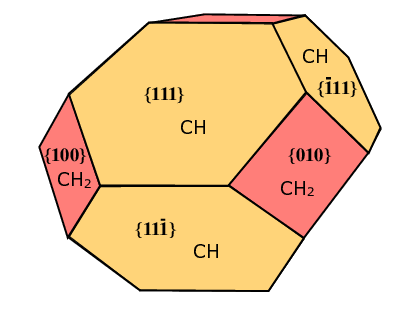
Schematic representation of nano-diamond surfaces featuring CH and CH2 groups on the facets.
Nanodiamonds hidden in the interstellar medium
Nano-diamonds are one of the most enigmatic components of cosmic dust. A significant fraction of presolar nano-diamonds extracted from primitive meteorites is associated with distant supernovae. Although they constitute numerous meteorites and have been observed in only two protoplanetary disks and one evolved star, they have never been observed directly in the interstellar medium. Using new calculations from the THEMIS dust model developed at IAS, we explain why observing nano-diamonds in space presents such a challenge.
In the diffuse interstellar medium, approximately 50% of carbon resides in dust. If 3% to 5% of this carbon were bound in nano-diamonds—matching presolar meteoric abundance—they would remain undetectable via thermal emission and extinction. The optical constants of nano-diamonds newly calculated using the THEMIS model indeed demonstrate that their infrared signatures would be masked by the emission features of other carbonaceous dust components (see figure below). Consequently, up to several percent of the available carbon budget could be concealed in the form of nano-diamonds.
For the few circumstellar regions where nano-diamond emission has been detected, observations using the MATISSE instrument at the VLTI will help constrain their spatial distribution at the astronomical unit scale. The goal is to gather data on their size, composition, and evolution, once again leveraging the THEMIS model. This could provide deeper insights into the properties of presolar meteoritic nano-diamonds (such as their dimensions, typically 2 to 3 nm). The optical constants calculated by THEMIS offer a robust method to investigate their presence and viability across a wide range of astronomical sources.
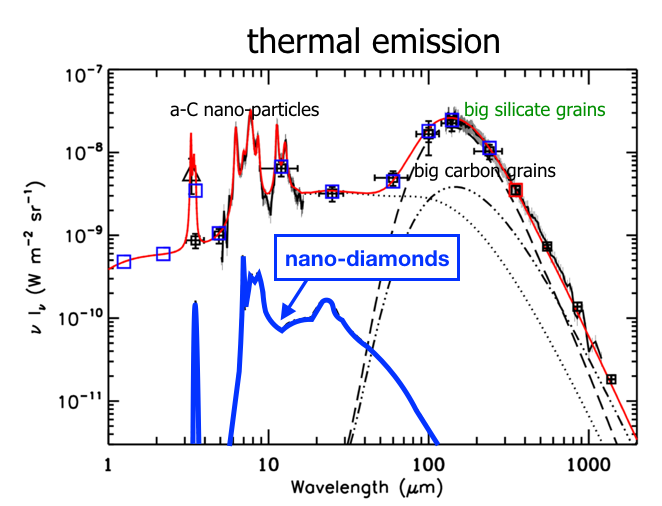
Emission spectra of diffuse interstellar dust components, including hydrogenated nano-diamonds (blue curve).
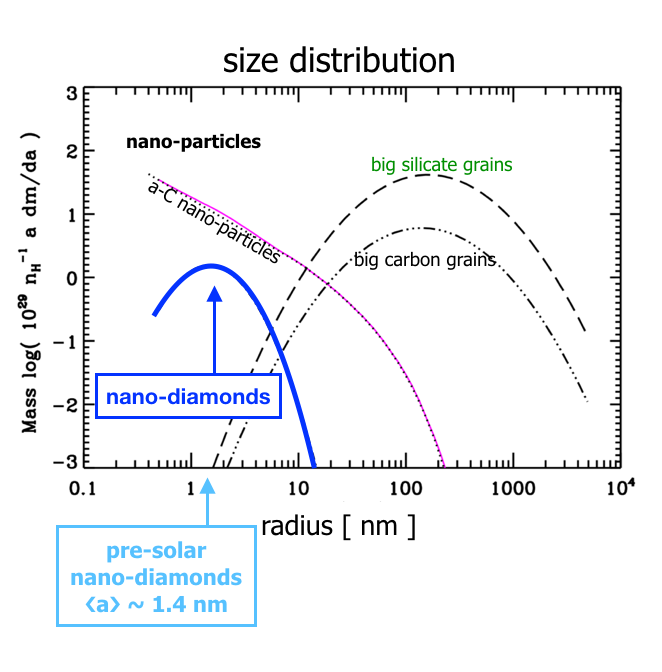
Size distribution of diffuse interstellar dust components, including hydrogenated nanodiamonds (blue line), with an abundance close to that found in meteorites.
Contacts
Scientific and Technical Contacts
- Anthony Jones, Senior Researcher, AMIS Team
- Nathalie Ysard
- Émilie Habart, Associate Professor, Head of the AMIS Team