
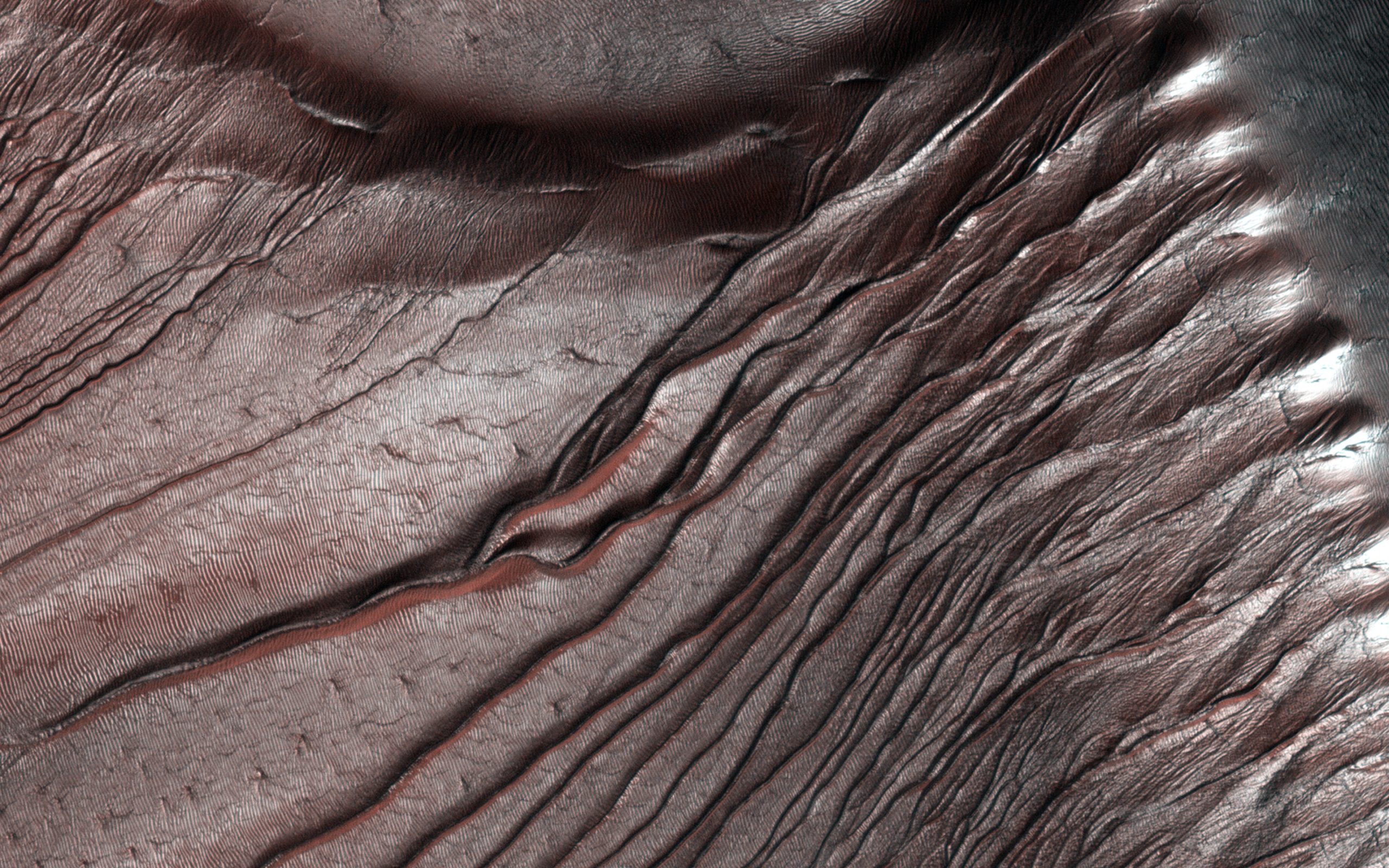
Exotic mechanisms involving dry ice as the origin of gullies on Mars
The gullies observed on Mars are believed to be formed by the action of CO2 ice during winter or spring, rather than by liquid water flows as previously suggested. Indeed, beneath the solar-heated CO2 ice, intense gas movements can destabilize and fluidize the ground, creating flows similar to those generated by a liquid.
Since 2000, onboard cameras on satellites orbiting Mars have sent back numerous images showing channels and debris fans, similar to those created on Earth by liquid water action on scree slopes, sometimes with a meandering path. The formation of these gullies appeared recent, ranging from a few million years to just a few years. This revived the idea that significant amounts of liquid water, potentially favorable to life, could form on Mars today.
The role of liquid water in the genesis of gullies has nevertheless recently been called into question by imagery from the Mars Reconnaissance Orbiter (MRO), obtained by regularly monitoring certain gully networks. These images revealed the ongoing formation of new channels during seasons when temperatures are far too low for liquid water, even saline, to contribute to liquid flow. Conversely, observations by HiRISE on MRO and a recent study conducted by M. Vincendon of IAS (using infrared spectroscopy data from the OMEGA instruments on Mars Express and CRISM on MRO) showed that the excavation of new channels appeared to occur when CO2 ice was present. But how can we explain that a thin layer of seasonal CO2 ice (a few tens of centimeters thick) can trigger the formation of flows involving dozens or even hundreds of m3 of material?
Numerical models by C. Pilorget (IAS) and F. Forget (LMD), which simulate the CO2 cycle on the surface and in the subsurface of Mars, have provided new insights into the mechanisms potentially at play. Specifically, these models demonstrated that intense gas movements exist beneath the solar-heated CO2 ice, which can potentially destabilize and fluidize the ground to the point of creating flows that mimic those generated by a liquid. Simulations performed for various latitudes and slopes have helped explain the spatial distribution and slope orientation of the sites where channel formation has been observed in recent years. By exploring the impact of Mars' obliquity, which has varied between 25 and 35° over the past million years of its history, a strong correlation was also observed between model predictions and the distribution of gullies on Mars. The identified mechanism, which does not require liquid water, could therefore represent a major process in the formation of Martian gullies, although the contribution of complementary processes cannot be ruled out.
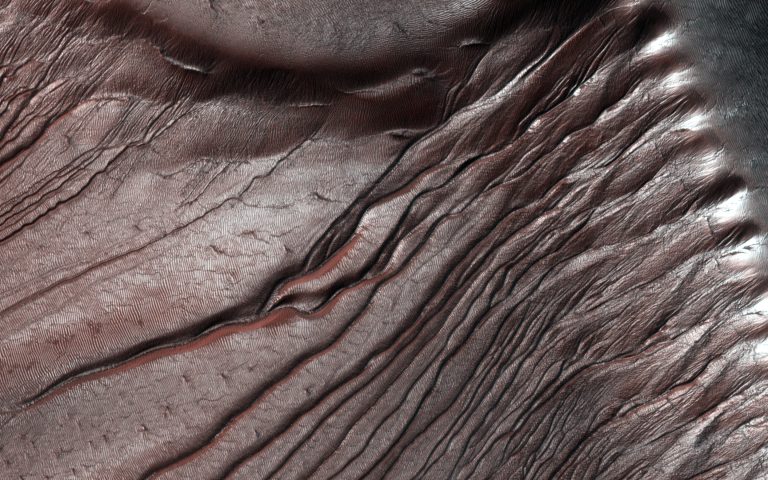
Meandering gullies on the walls of a crater in the Newton basin (41°S-202°E).
Credit: NASA/JPL/University of Arizona
Contacts
Scientific and Technical Contacts
Cédric Pilorget, Senior Lecturer, Paris-Saclay University, Solar System and Planetary Systems Physics Team
References
Article: Pilorget C. and F. Forget. “Formation of gullies on Mars by debris flows triggered by CO2 sublimation”. Nature Geoscience (2016). DOI 10.1038/ngeo2619
CNRS/INSU Press Release: http://www.insu.cnrs.fr/node/5591