
Mysterious high-redshift galaxies discovered by Planck and Herschel
An international team, led by astrophysicists from IAS and IRAP, has used ESA's Planck and Herschel satellites to discover new and enigmatic distant galaxies forming impressive quantities of stars.
Most of these distant galaxies share the peculiar characteristic of being strongly clustered, potentially representing the elusive forming galaxy clusters researchers have long sought. Others appear isolated yet highly luminous, and have been confirmed as gravitationally lensed galaxies. These newly discovered, highly active star-forming distant galaxies can help scientists address a central issue in cosmology: how large-scale structures form in the Universe.
From the perspective of galaxy evolution, studying cosmic epochs when galaxies actively formed stars within dark matter halos can provide a wealth of observational constraints. These include the kinematics and evolutionary history of galaxies in massive clusters as well as intra-cluster gas[1]. From a cosmological standpoint, galaxy clusters yield insights into the baryonic content of the Universe, mass aggregation into large-scale structures, and potential primordial non-gaussianities[1]. The search for distant galaxy clusters and/or distant gravitationally lensed galaxies thus represents one of the hottest topics in contemporary observational cosmology. Within this framework, the European Space Agency's (ESA) Planck satellite has the potential to discover these rare objects across the entire sky, while ESA's Herschel space observatory can examine them in exhaustive detail.
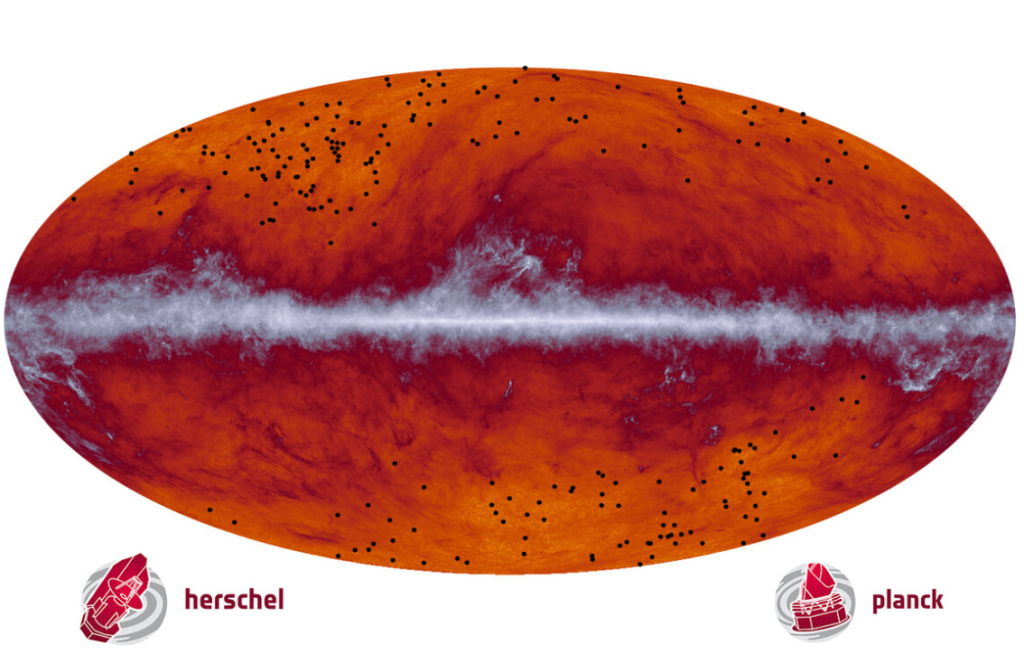
The Planck satellite provided the first all-sky map in submillimeter wavelengths (beyond the infrared and approaching radio waves) with the sensitivity required to systematically identify the rarest, most luminous high-redshift submillimeter sources[2] in the sky. These sources can either be gravitationally lensed galaxies or the cumulative far-infrared and submillimeter emission from a population of intensely star-forming galaxies. Predicted by models, these galaxy groupings are expected to reside within the most massive dark matter halos that rapidly grow and contract, enclosing gas and galaxies. They constitute precisely the elusive, high-redshift proto-clusters sought after by astronomers. Little is known about these galaxy groups, prompting Planck scientists to initiate a dedicated, systematic all-sky search that has yielded numerous candidate discoveries. Because these rare objects are detected by Planck, astrophysicists require follow-up observations for detailed characterization. Herschel has consequently observed over 200 of these targets—under a unique program utilizing exceptional discretionary time granted before the mission's end—revealing surprising results.
“We were immediately surprised by the high flux of certain galaxies or the strong angular concentration of others. The discovery of so many starburst galaxies densely packed into small regions of the sky was striking. We may be witnessing a mysterious and missing episode in our understanding of cosmological large-scale structure formation: the phase where galaxy groups undergo intense star formation at high redshift, potentially serving as proto-clusters and precursors to today's massive galaxy clusters,” explains Pr Hervé Dole (IAS, Orsay, CNRS and Univ. Paris-Sud), who leads the analysis conducted within the Planck collaboration, which involves multiple laboratories across France, Europe, and the United States.
“Most targets are selected from Planck data using a dedicated method that exploits minute fluctuations in images whose signals are consistent with the presence of high-redshift galaxies ,” explains Dr. Ludovic Montier (IRAP, Toulouse, CNRS and Univ. Paul Sabatier), who developed the detection and selection methodology. Dr. Mattia Negrello (INAF, Italy) adds, “a few additional targets were chosen from Planck's 2013 catalog of compact sources, the PCCS.”
« Both selection methods, whether from images or catalogues, rely on the same color selection principle, which favors the presence of galaxies at a redshift greater than two, corresponding to approximately 3 billion years (or less) after the Big Bang; it remained for Herschel's observations to demonstrate that the correct sources had indeed been chosen! », adds H. Dole.
« Herschel's angular resolution and high sensitivity then enable us to unveil the nature of the high-redshift Planck candidates », explains David Guéry (IAS), a PhD student overseeing the analysis of Herschel data. « We are able to identify in the Herschel images either single, highly luminous galaxies—a potential signature of gravitationally lensed galaxies—or concentrations of red galaxies, which may indicate galaxy overdensities and potential galaxy clusters », he continues.
Dr. Nicole Nesvadba (IAS) adds that « some of our galaxies are so gravitationally lensed that they rank among the brightest ever detected in the sky, and their detailed analysis is currently underway ». Clément Martinache (IAS), a PhD student responsible for the near-infrared analysis, points out that « certain galaxy overdensities discovered by Planck and Herschel, suspected to be proto-clusters, are also observed in the near-infrared, where they exhibit concurrent and unequivocal signs of aggregation into galaxy clusters. »
In summary, astrophysicists have discovered that most high-redshift Planck candidates are intensely star-forming galaxy concentrations, exhibiting star formation rates typically exceeding 500 times that of our Galaxy. Crucially, numerous indicators suggest they may represent high-redshift clusters (z > 2). This significant discovery reveals large-scale structures during their intense star-forming phase—likely corresponding to their formation phase—never before observed with such high detail and across such a broad sample. Furthermore, a few gems have been detected in the remaining data: ultra-luminous, high-redshift galaxies amplified by gravitational lensing, enabling physical studies of gas composition and dynamics as detailed as those conducted in nearby galaxies. These initial findings are published in a scientific paper in the journal Astronomy & Astrophysics by the Planck Collaboration. [1]
« This program perfectly highlights the synergy between Planck and Herschel », explains Prof. Douglas Scott (UBC, Vancouver). « Planck first selects the most compelling targets across the entire sky, after which Herschel zeroes in on these points for finer analysis. » Each space mission is utilized to its utmost, complementary capabilities in a synergistic manner.
« Planck is a fantastic experiment optimized for studying the cosmic microwave background, while simultaneously enabling major breakthroughs in other scientific fields », explains Dr. Jean-Loup Puget (IAS), the Planck project scientist. « As recently demonstrated regarding galactic magnetic fields and the polarized light of Galactic dust, or here regarding the formation of large-scale structures and high-redshift galaxies. »
Dr. Bruno Altieri (ESA) adds: « Herschel has already uncovered numerous distant galaxies in deep surveys, but this time it allows us to open a new window with these bright, lensed galaxies and candidate forming clusters at high redshift. »
H. Dole concludes: « This new program, whose data were acquired a few years ago during concurrent observations by Planck and Herschel, is only just beginning. Following the discovery of these high-redshift, intensely star-forming candidates, we are now conducting follow-up observations of numerous interesting targets using other ground-based and space observatories. Moreover, this striking synergy between two major missions of the European space program, Planck and Herschel, has been made possible by the dedicated work of numerous colleagues worldwide, as well as the Planck and Herschel scientific teams. This is a remarkable team effort, and further exciting results are anticipated in the months ahead as we also prepare for the future with Euclid, ESA's upcoming cosmology mission. »
Notes
The scientific paper, in press in the journal Astronomy and Astrophysics, is entitled: « High-redshift infrared galaxy overdensity candidates and lensed sources discovered by Planck and confirmed by Herschel-SPIRE », and is authored by the Planck Collaboration with H. Dole as the primary contact.
This work, conducted within the framework of CNRS and Univ. Paris-Sud, has received support from CNES, CNRS (PNCG), the Île-de-France region, and ANR.
This work has also been communicated to ESA, INSU, CNES, Univ Paris-Sud, IRAP, as well as internationally: Italy, Spain, the United Kingdom, Canada, and the United States (JPL, UofA).
[1] Primordial non-Gaussianities are fluctuations predicted by certain models.
[2] Redshift (or cosmological redshift) is a measure related to the cosmological distance of an object.
About Planck
Launched in 2009, Planck was designed to map the sky across nine frequencies using two state-of-the-art instruments: the Low Frequency Instrument (LFI), covering the 30–70 GHz frequency bands, and the High Frequency Instrument (HFI), covering 100–857 GHz. HFI completed its survey in January 2012, while LFI continued scientific observations until October 3, 2013, before being switched off on October 19, 2013.
Planck's first all-sky image was released in 2010, and initial scientific data were published in 2011. The first image of the cosmic microwave background was released in March 2013. The next set of cosmological results, including polarization data, will be published in December 2014.
The Planck Scientific Collaboration consists of all scientists who contributed to the mission's development and participate in the scientific exploitation of the data during the proprietary period. These scientists are members of one or more of the four consortia: the LFI Consortium, the HFI Consortium, the DK-Planck Consortium, and the ESA Planck Science Office. Planck's two data processing centers are located in Paris, France, and Trieste, Italy. The LFI consortium is led by N. Mandolesi, Agenzia Spaziale Italiana ASI, Italy (vice-PI: M. Bersanelli, Università degli Studi di Milano, Italy), and was responsible for the development and operation of LFI. The HFI consortium is led by J.-L. Puget at IAS (vice-PI: F. Bouchet, Institut d'Astrophysique de Paris) and was responsible for the development and operation of HFI. CNES supported the development of HFI, its data processing center (DPC), and its operations.
More information at http://www.planck.fr and http://www.cosmos.esa.int/web/planck
About Herschel
ESA's Herschel space observatory comprises the largest and most powerful infrared telescope ever deployed in space. As the first observatory to cover the entire far-infrared to submillimeter wavelength range, Herschel is sensitive to the far-infrared well beyond any previous mission. It enables the study of invisible, cold regions of the nearby and distant Universe obscured by interstellar dust.
The observatory features three state-of-the-art scientific instruments: two cameras and a very high-resolution spectrometer.
More information at http://www.herschel.fr