
Ryugu samples protected from the solar wind… but not all of them!
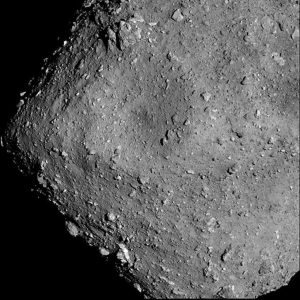
In December 2020, the Hayabusa2 spacecraft brought back to Earth 5.4 grams of samples from the primitive asteroid Ryugu. These grains were collected from two locations, one of which was following an artificial impact that excavated subsurface material. The entire collection is being analyzed at JAXA’s Curation Facility (Sagamihara, Japan) under a controlled atmosphere to prevent contamination of the samples by Earth’s atmosphere.
Analysis of approximately 100 millimeter-sized grains using the MicrOmega instrument—a near-infrared hyperspectral imager developed at the IAS—revealed variations in the composition of phyllosilicates between grains from the two collection sites. These compositional variations are linked to space weathering, a process that affects the physical and compositional properties of asteroid surfaces and involves bombardment of these surfaces by micrometeorites, solar wind ions, and cosmic ray irradiation. The spectral properties of the subsurface grains suggest that they have never been exposed to the space environment.
The study of the molecular composition of millimeter-sized grains also showed that Ryugu’s grains as a whole contain much less water than CI-type carbonaceous chondrites, even though the latter have a mineralogical and elemental composition similar to that of Ryugu. This difference suggests that some of the water in carbonaceous chondrites may have originated from contamination by Earth’s atmosphere. The Ryugu samples thus serve as new benchmarks for characterizing the abundance of water in primitive bodies in the solar system.
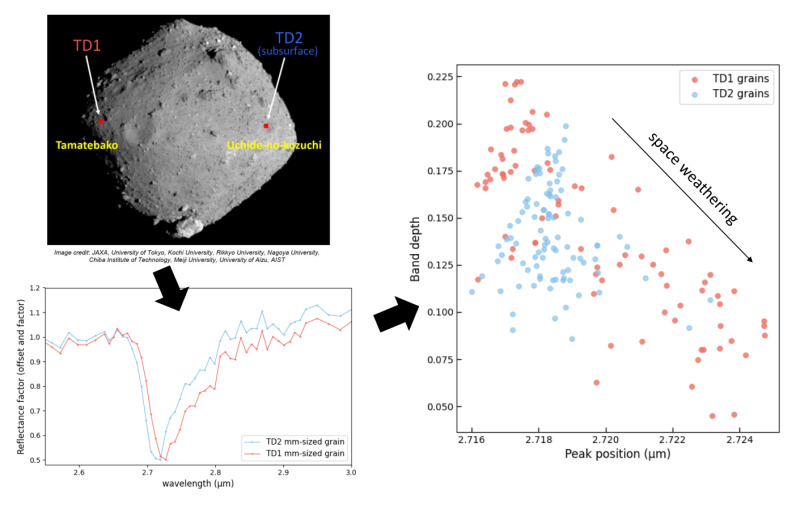
In the order of the arrows: A: The two sample collection sites on the surface of the asteroid Ryugu. B: Absorption band at 2.7 µm observed in the near-infrared spectra of millimeter-sized grains from Ryugu. C: Scatter plot of depth versus peak position of the 2.7 µm band.
© A: JAXA, University of Tokyo, Kochi University, Rikkyo University, Nagoya University, Chiba Institute of Technology, Meiji University, University of Aizu, AIST.
Contacts
- Tania Le Pivert-Jolivet, Ph.D. candidate at the IAS and postdoctoral researcher at the IAC
- Rosario Brunetto, Research Scientist, Astrochemistry & Origins Team
- Cédric Pilorget, Associate Professor at Université Paris-Saclay, Équipe Physique du système solaire et des systèmes planétaires
References
- CNRS-INSU News
- Scientific article: Le Pivert-Jolivet, T., Brunetto, R., Pilorget, C., et al. “Space weathering record and pristine state of Ryugu samples from MicrOmega spectral analysis.”Nat Astron (2023).