JAXA's (Japan) Hayabusa2 sample-return mission is dedicated to studying the carbonaceous (C-type) near-Earth asteroid (162173) Ryugu. The objectives are to determine its composition, origin, history, and potential links with meteorites collected on Earth, as well as with other primitive asteroids. After characterizing Ryugu's surface (notably with the NIRS3 instrument, for which several IAS researchers are Co-Investigators), Hayabusa2 performed two surface sampling operations directly on the asteroid. Following the recovery of the capsule in December 2020, the 5.5 g of collected samples were transported to JAXA's curation facility (ISAS, Sagamihara, Japan) for sorting, cataloging, and pre-characterization using entirely non-destructive techniques. Among these techniques is near-infrared hyperspectral imaging (1–3.6 µm) performed using the MicrOmega instrument developed by the IAS Planetary Science team. This phase is ongoing.
A preliminary analysis phase organized by JAXA began in June 2021. It involves several international teams organized around well-defined scientific objectives, such as determining the elemental and isotopic composition of the samples, studying the mineralogy and petrology of large grains and finer particles, analyzing volatile compounds (extracted before opening the capsule), and characterizing the soluble and insoluble organic components extracted from the collected grains.
The Astrochemistry and Origins team at IAS, in collaboration with the SMIS beamline at the SOLEIL synchrotron, is involved in analyzing the Ryugu grains, largely thanks to the Fourier-transform infrared (FTIR) micro-tomography technique recently implemented at SOLEIL by IAS and SMIS. We are part of the international coordinated analysis team in Japan led by T. Nakamura (Tohoku University, Sendai), and our contribution will primarily focus on mid- and far-infrared micro-spectro-imaging (2–50 µm). We will concentrate on the interactions between mineral and organic phases (intimately mixed in primitive extraterrestrial materials at sub-micrometric scales) to better understand the physical chemistry connecting them. One of our main objectives will be the detection of hydrated materials and the reconstruction of Ryugu's past aqueous alteration history. The study of these small samples will thus provide us with valuable insights into the formation conditions and evolutionary processes of matter in the early Solar System.
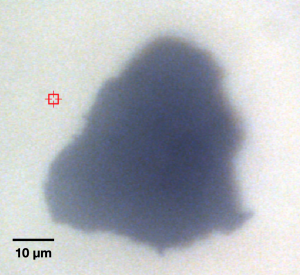
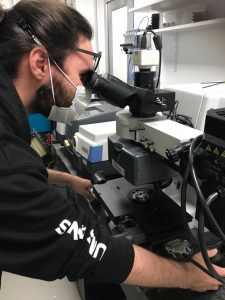
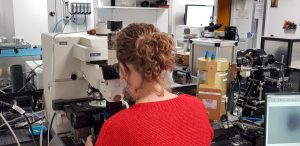
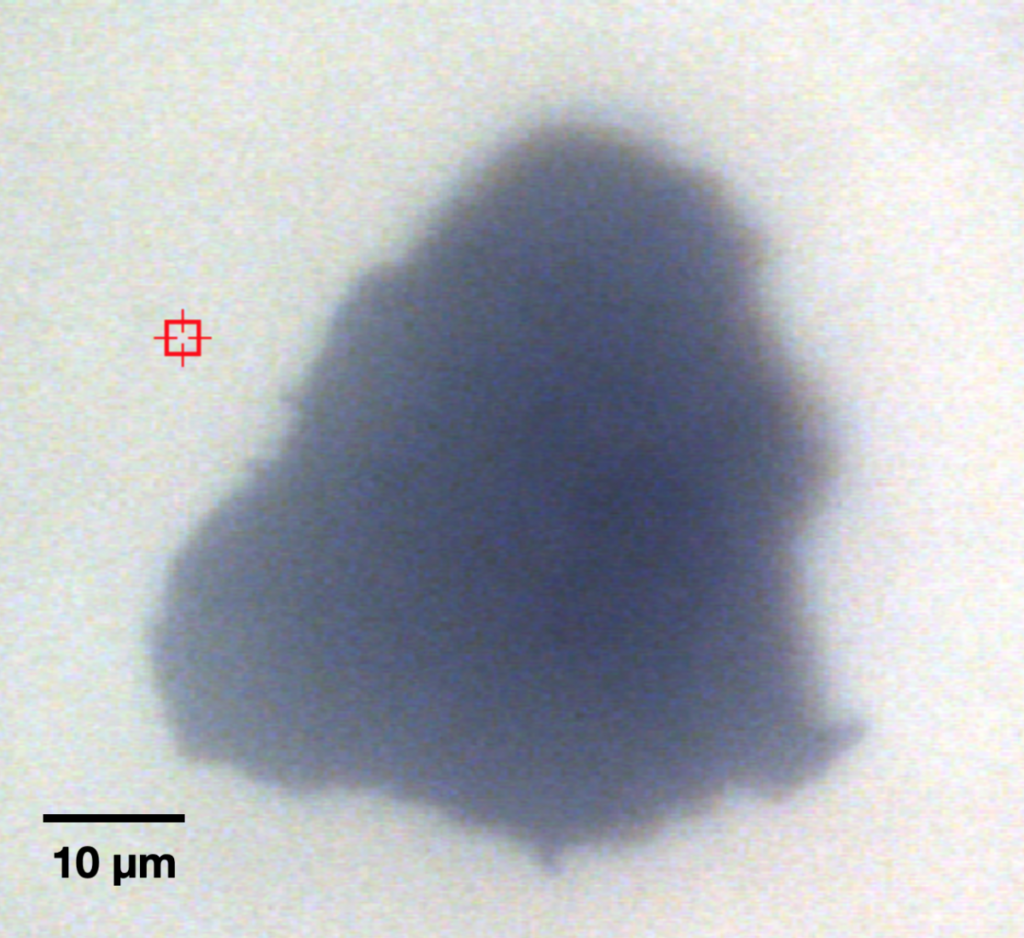
After a long journey, several dozen small grains from Ryugu have finally arrived at IAS. The Astrochemistry and Origins team has received them, and a series of preliminary checks and measurements has begun using various microscopes at IAS and the SMIS beamline at SOLEIL (Figure 2). Following this initial analysis phase, grains will be selected and mounted onto metallic tips using an original procedure developed in collaboration with D. Troadec (IEMN, Lille) and E. Héripré (CentraleSupélec, Saclay). These grains will then be ready for the next crucial stage of our work: characterization via infrared micro-tomography.