
DOIs are commonly used to declare and uniquely identify scientific publications, but they can also be associated with software or datasets. This is why they are now utilized by IDOC.
DOIs were created to overcome URL obsolescence. Thanks to DOIs, you can retrieve the location of a digital resource even if it is moved. Take the example of the second dataset delivered by the SPICE instrument on the Solar Orbiter mission: its raw DOI format is 10.48326/idoc.medoc.spice.2.0. The web address (URL) corresponding to a DOI can be obtained by simply appending the prefix https://doi.org/. Thus, the address https://doi.org/10.48326/idoc.medoc.spice.2.0 will always locate this dataset regardless of changes to its supporting infrastructure, environment, or access software. The accessed resource must be described on the landing page pointed to by the DOI, along with all elements necessary for its optimal use.
Several platforms are authorized to assign these DOIs. CrossRef, mEDRA, and DataCite are the primary agencies or associations tasked since the 2000s with issuing these persistent identifiers. DataCite, via the CNRS Institute for Scientific and Technical Information (INIST), delegates the registration of our DOIs to IDOC under an annually renewable contract.
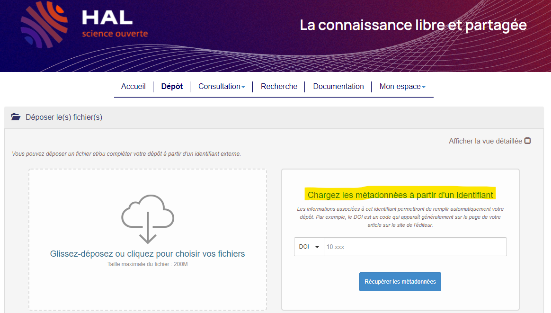
Identifying a resource by its DOI also facilitates feeding other platforms or data repositories. Furthermore, its use is recommended by the Practical Guide of the CNRS Ethics Committee (COMETS). In the HAL (CNRS) database, for example, simply entering a document's DOI is sufficient to upload it. The repository then automatically imports its associated metadata (author, publication type, publication title, date, etc.).
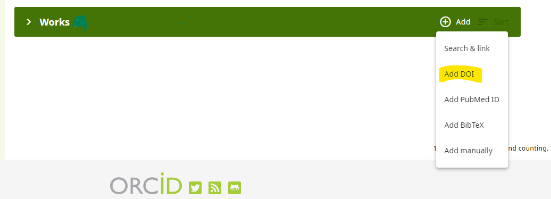
Similarly, it is possible to import all document metadata into ORCID (Open Researcher and Contributor ID) using its DOI, or to search for an article in the ADS bibliographic database via its DOI.
Today, 83 codes and datasets hosted by IDOC are identified by their DOI.