
Phosphorus compounds with high biochemical potential in the grains of the asteroid Ryugu
Small bodies of the Solar System are the vestiges of a turbulent history dating back over 4.5 billion years. Determining the composition of these objects helps constrain models of Solar System formation and evolution, and provides a clearer picture of their potential chemical contributions to the primitive Earth. The return of samples from the asteroid Ryugu by JAXA's Hayabusa2 mission offers, for the first time, the opportunity to analyze pristine, carbon-rich "primordial" extraterrestrial matter in a laboratory setting, meaning it has undergone no terrestrial alteration (1). The work reported here has led to the discovery of highly specific phosphorus compounds with major biochemical potential.
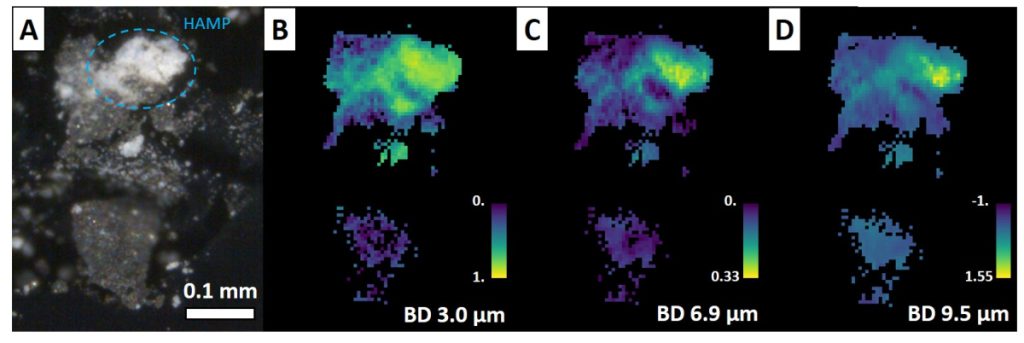
These compounds were identified and characterized through an international collaboration that conducted coupled measurements: first inside the sample containment facility at ISAS (Japan) using the MicrOmega instrument developed by IAS (France), and subsequently in research centers in Japan, France (Synchrotron SOLEIL and IAS), and the United Kingdom, on grains extracted from the collection. These analyses made it possible to identify a category of hydrated compounds rich in ammonium, magnesium, and phosphorus (''HAMP'') present as grains and inclusions measuring up to several hundred microns in size.
The discovery of HAMP supports the idea that the material comprising Ryugu must have accreted and partially evolved in the outer Solar System, far from its current region. Crucially, a key characteristic of these compounds is that they may have promoted the release and subsequent reaction of phosphorus- and nitrogen-rich species upon immersion in primitive terrestrial water reservoirs. They could thus have played an essential role in the evolution toward life on Earth.
(1) Extraterrestrial materials collected on Earth (meteorites, micrometeorites, and interplanetary dust) have all undergone a certain degree of alteration or modification caused by their interaction with the terrestrial environment during atmospheric entry or subsequently, during their prolonged stay on the surface.
Example of a HAMP inclusion found in the Ryugu samples (A). Infrared mapping performed on this sample characterizes the inclusion by its specific abundance of water (B), ammonium (C), and phosphorus (D). Credits: Pilorget, C. et al. Phosphorus-rich grains in Ryugu samples with major biochemical potential. Nature Astronomy, 2024
Contacts
- Cédric Pilorget, Associate Professor at Université Paris-Saclay, Équipe Physique du système solaire et des systèmes planétaires
- Donia Baklouti, Associate Professor, Astrochemistry & Origins Team
- Jean-Pierre Bibring, Professor at Université Paris-Saclay, Solar System and Planetary Systems Physics Team
References
- Link to the online publication: https://www.nature.com/articles/s41550-024-02366-w
- Link to the Université Paris-Saclay/CNRS/CNES press release : https://www.cnrs.fr/fr/presse/lanalyse-dechantillons-de-lasteroide-ryugu-livre-de-nouvelles-perspectives-sur-levolution