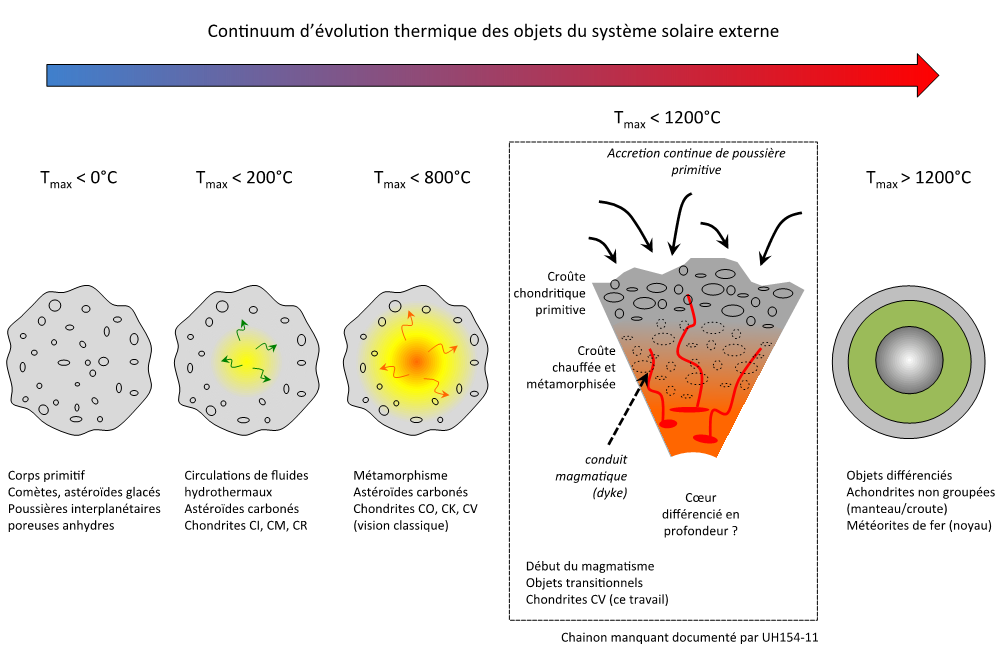
Over the past decade, the magnetism of primitive meteorites and advances in the isotopic characterization of planetary bodies have revealed a link between the most primitive meteorites—carbonaceous chondrites—and certain differentiated planetary bodies sampled by iron meteorites. These data suggest the existence of transitional bodies with a layered internal structure—a metallic core and a silicate mantle—covered by a chondritic crust composed of primitive materials from the protoplanetary disk in which the planets formed. However, this idea remained unproven due to the lack of meteorite samples from the very early stages of partial melting during planetary differentiation.
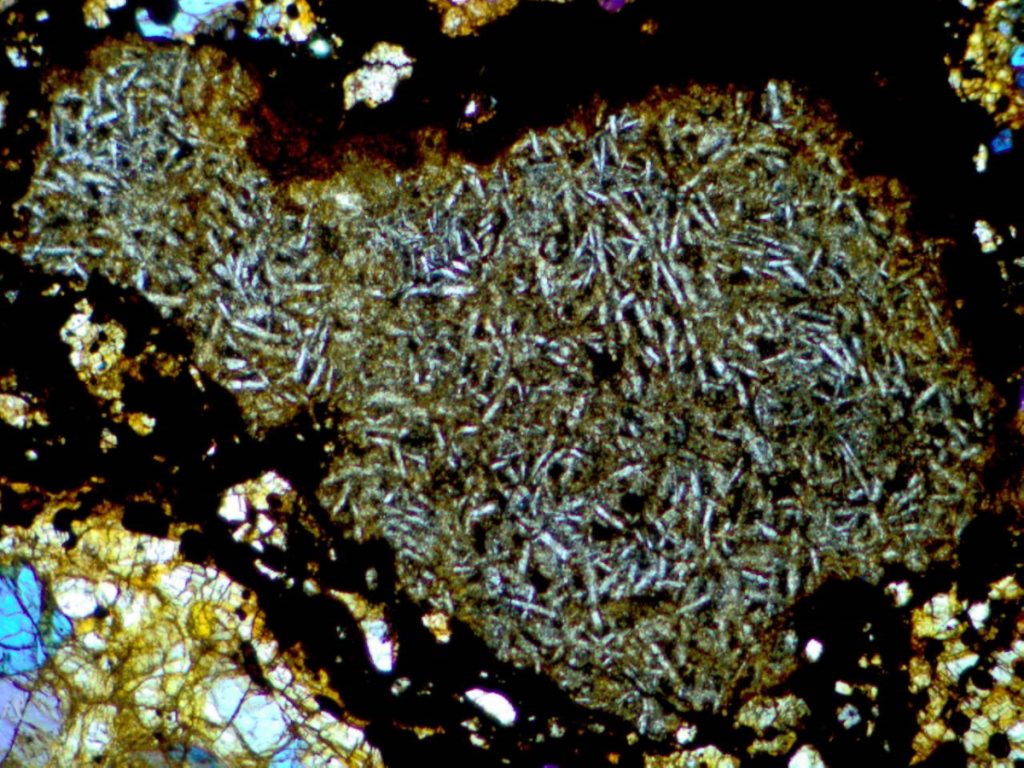
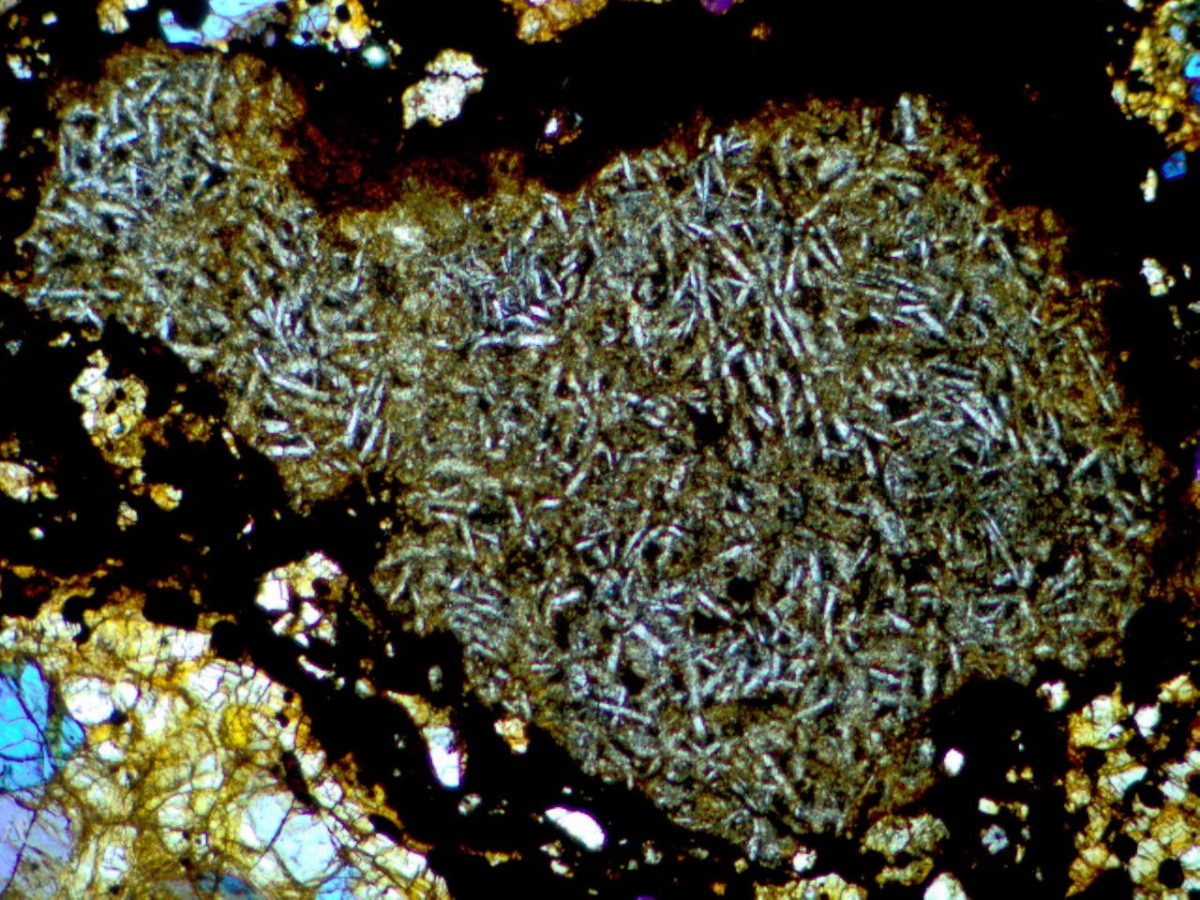
A recent study reported the mineralogical, petrological, and isotopic characterization of UH154-11, a lava fragment discovered as an inclusion in a carbonaceous chondrite of the CR group (Renazzo group). UH154-11 is an iron-rich trachybasalt whose oxygen isotope composition links it to carbonaceous chondrites from another group, the CV chondrites (Vigarano group). Its chemistry indicates an origin by partial melting—with a very low degree of partial melting (a few percent)—of a chondrite that was already oxidized and enriched in sodium due to prior fluid circulation during a metamorphic episode. Its texture, meanwhile, indicates crystallization accompanied by very rapid cooling, which increased as crystallization progressed. This property is characteristic of magmas rising through magmatic conduits and rules out an impact origin. UH154-11 therefore resulted from the crystallization of a magma formed at depth at approximately 1,100°C that percolated toward the surface of a very primitive carbonaceous body. The temporal constraints provided jointly by magnesium isotopes and by its formation from a pre-metamorphosed precursor indicate that it formed approximately 4 million years after the collapse of the parent molecular cloud and the beginning of the solar system’s formation.
The distinctive properties of UH154-11 thus indicate that some of the most primitive objects in the solar system were indeed heated to the point of initiating layered planetary differentiation, and that partially differentiated transitional objects existed early in the history of the solar system. UH154-11 can therefore be considered the missing link between carbonaceous chondrites—to which comets are related—and certain differentiated objects, such as some families of iron meteorites derived from the metallic cores of carbonaceous planetesimals that underwent complete planetary differentiation.