
Galaxy Clusters Discovered in Planck Data Using Artificial Intelligence
For the first time, by leveraging innovative artificial intelligence methods, an IAS team has discovered thousands of galaxy clusters in observations from the Planck satellite, which have been published in a new catalog.
Data from the Planck satellite have already been used three times within the collaboration to produce catalogs of galaxy clusters (ESZ-2009, PSZ1-2013, PSZ2-2015) by detecting the Sunyaev–Zeld’ovich (SZ) effect, which traces the hot gas in galaxy clusters. The technique used was adaptive multi-frequency filtering applied to the six frequencies of Planck’s High Frequency Instrument (HFI).
In this brand-new analysis, the authors followed a two-step process. First, an all-sky map of the SZ effect was created using the six HFI maps. Next, a neural network trained on known clusters was applied to eliminate pixels from the map that had a very low probability of tracing hot gas. A filter was then used to retain only the sets of pixels tracing galaxy clusters. The resulting final catalog contains nearly 4,000 galaxy cluster candidates, of which only 10% have non-negligible probabilities of being false positives. This new catalog is made available to the scientific community through the IDOC (IAS) SZ galaxy cluster database (szcluster-db.ias.u-psud.fr) and via the CDS (Strasbourg Data Center).
This analysis is the result of extensive work over several years dedicated to the production and validation of the Planck galaxy cluster catalogs. This validation process, which combines statistical analyses and physical characteristics, had already been improved using neural networks (Aghanim et al. 2015). Another artificial intelligence technique, based on decision trees, had also made it possible to characterize cluster galaxies by estimating their stellar mass and star formation rate (Bonjean et al. 2019). The next steps will involve using unsupervised artificial intelligence algorithms—guided by the physics of galaxy clusters—to capitalize on their ability to detect weak signals and separate components simultaneously. An R&D study (funded by CNES), as well as a doctoral thesis, are currently underway on this topic.
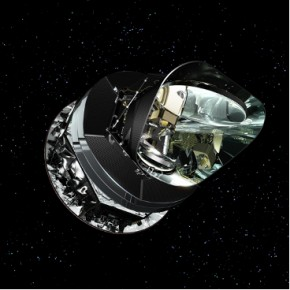
Figure 1: Planck Satellite
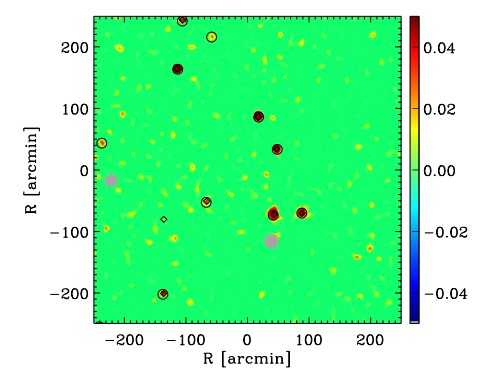
Figure 2: Map of hot gas viewed in the SZ for a portion of the sky, processed using artificial intelligence. The black circles indicate detections, while the gray regions are masked due to contamination from point sources.
Contacts
Advisors (scientific and technical)
- Nabila Aghanim, Research Director, Cosmology Team
- Marian Douspis, Astronomer, Cosmology Team
References
The corresponding article was published in A&A (Hurier, Aghanim, Douspis 2021).