
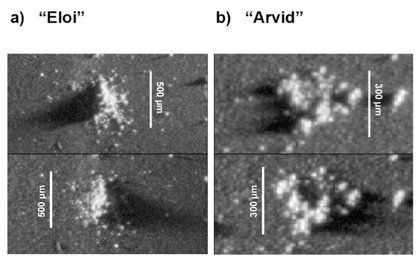
Since the Rosetta spacecraft entered orbit around Comet Churyumov-Gerasimenko in August 2014, its COSIMA instrument has been exposing targets to collect cometary grains. The results have exceeded all expectations, with collected particles reaching sizes of up to several hundred micrometers, many of which are aggregates. This is the first time that cometary grains have been collected at very low speeds (less than 10 m/s) in the immediate vicinity of the nucleus, allowing them to be characterized just a few hours after their formation.
COSIMA is a time-of-flight mass spectrometer led by Germany (MPS Göttingen). It includes a microscope (COSISCOPE), developed at the IAS, designed to detect the collected grains by comparing images taken before and after exposure. The mass spectrometer’s ion gun was also developed in France (LPC2E).
Many of the collected particles fragmented upon impact with the target and have a “flaky” appearance. These particles, rich in sodium (Na), originate from the layer of dust that has accumulated on the comet’s surface since its last close approach to the Sun. The dust particles observed by COSISCOPE share many characteristics with interplanetary dust particles (IDPs), which exhibit a similar aggregate structure down to scales smaller than the COSISCOPE pixel (14 µm). This supports the hypothesis that IDPs originate primarily from comets. These results were published in the January 26, 2015, issue of *Nature* and were the subject of a “press alert” from the CNRS.