
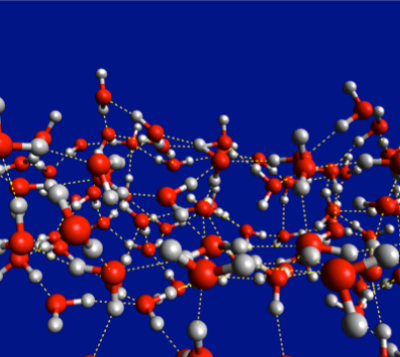
Interstellar Ice Under Heavy Cosmic Radiation
A multidisciplinary team comprising researchers from the IAS, CIMAP, IPNO, GANIL, and the PUC Catholic University of Rio de Janeiro has characterized in the laboratory the effect of heavy cosmic rays on the structure and pulverization of water ice in interstellar and planetary environments. These experiments allow for the study of phase changes induced by heavy ions, similar to galactic cosmic rays. They complement and expand upon the knowledge already gained at lower energies. In addition to phase changes, this study reveals the importance of the emission rates of water molecules into space by galactic heavy ions—or the vaporization—of interstellar ice present in dense, cold interstellar clouds.
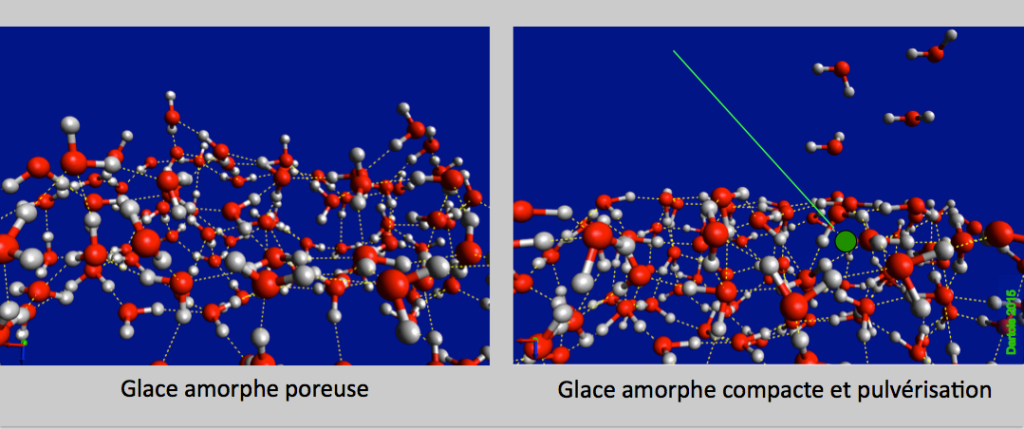
Laboratory simulations and measurements of radiation-induced processes observed in space help to constrain their significance. The goal of these studies is to provide data on the evolution of interstellar matter, to understand its future evolution, and to provide constraints for modelers of astrophysical environments.
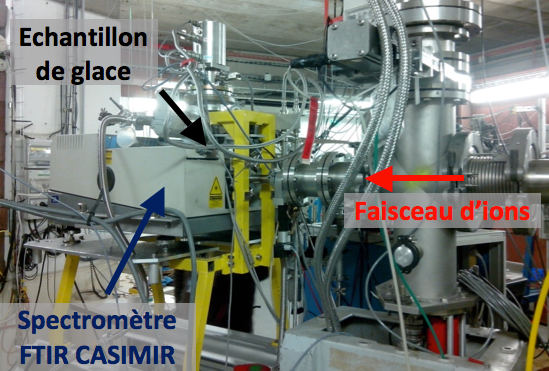
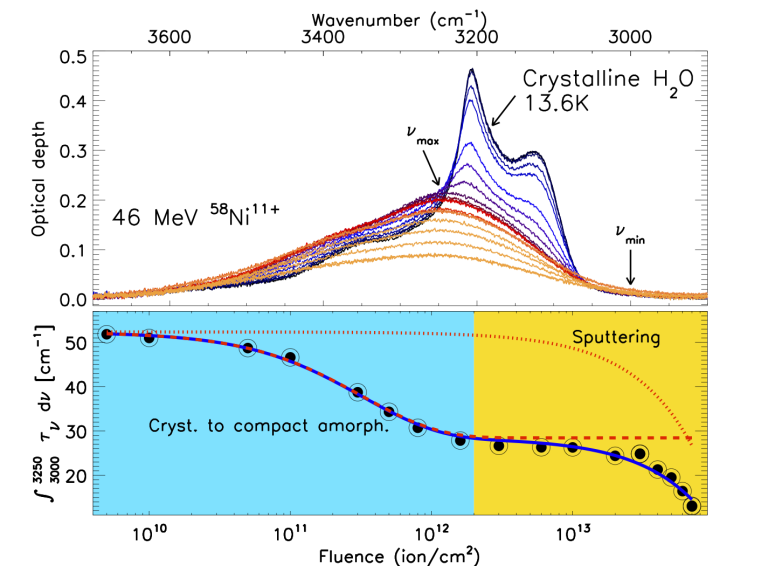
For these experimental simulations, water vapor is condensed into a thin layer of ice on a substrate maintained at a temperature at which the resulting ice is crystalline or amorphous (at very low temperatures, the ice formed by condensation is disordered and porous). The effects of irradiation by heavy ions from the GANIL accelerator are then studied as a function of temperature using infrared spectroscopy, which offers the dual advantage of allowing us to track the structural evolution of the ice and to determine the number of molecules re-emitted into the vacuum. All operations are performed in situ in a device developed by CIMAP.
Under heavy-ion irradiation, regardless of the ice’s initial state—whether crystalline or amorphous and porous—the irradiation leads to the same end state: compact amorphous ice; however, the compaction process is three times more efficient than the amorphization of the crystalline phase. Whether due to the mechanisms of water ice formation on the surfaces of interstellar grains, UV irradiation, or cosmic ray irradiation, the structure of ice in space evolves toward a compact phase, which explains why no porous amorphous ice has been observed to date.
These experiments show that among the particles present in galactic radiation, very high-energy heavy ions—although they constitute a minority in terms of abundance—have a major impact due to their very high efficiency. The high pulverization rates—particularly for water ice—are significant compared to other re-injection mechanisms, such as photodesorption by ultraviolet photons present in space. They provide an efficient mechanism for re-injecting a portion of the ice mantles present in molecular clouds back into the gaseous phase.
This experimental research is described in a series of articles, the latest of which has just been published in the journal *Astronomy & Astrophysics*.
Contacts
Advisors (scientific and technical)
Emmanuel Dartois, IAS, CNRS
Philippe Boduch and Hermann Rothard, Research Center for Ions, Materials, and Photonics, CEA/CNRS/ENSICAEN/University of Caen-Basse-Normandie, Caen, France.
References
Related publications:
- Heavy-ion irradiation of crystalline water ice, cosmic-ray amorphization cross-section, and sputtering yield, E. Dartois, B. Augé, P. Boduch, R. Brunetto, M. Chabot, A. Domaracka, J.J. Ding, O. Kamalou, X.Y. Lv, H. Rothard, E.F. da Silveira5, and J.C. Thomas4, Astronomy & Astrophysics 576 (2015) A125, doi: 10.1051/0004-6361/201425415
- “Compaction of porous ices rich in water by swift heavy ions,” C.F. Mejía, A.L.F. de Barros, E. Seperuelo Duarte, E.F. da Silveira, E. Dartois, A. Domaracka, H. Rothard, and P. Boduch, *Icarus* 250 (2015) 222–229, doi: 10.1016/j.icarus.2014.12.002
- “Swift Heavy-Ion Irradiation of Water Ice at MeV to GeV Energies, Approaching True Cosmic-Ray Compaction,” E. Dartois, J.J. Ding, A.L.F. de Barros, P. Boduch, R. Brunetto, M. Chabot, A. Domaracka, M. Godard, X.Y. Lv, C.F. Mejia Guaman, T. Pino, H. Rothard, E.F. da Silveira, and J.C. Thomas, *Astronomy & Astrophysics* 557 (2013) A97, doi: 10.1051/0004-6361/201321636
Notes:
The results were obtained through experiments conducted on the Irrsud, SME, and LISE lines at GANIL. This work was supported by the ANR IGLIAS projects, as well as by INSU, INP, CNRS, the University of Caen, the University of Paris-Sud, and the PUC Catholic University of Rio de Janeiro.