
COSIMA, a Rosetta instrument, sheds light on the composition of Comet 67P
An international scientific team including researchers from the IAS has determined the elemental composition of the dust from Comet 67P/Churyumov-Gerasimenko, which was explored by the European Rosetta space mission. These measurements, obtained by the COSIMA instrument, reveal one of the most carbon-rich and least altered materials ever explored. This cometary carbon is found primarily in the form of macromolecular organic matter, and it is therefore mainly in this form that it was likely brought to the early Earth by comets.
The European space probe Rosetta orbited the nucleus of Comet 67P/Churyumov-Gerasimenko for two years and studied it in great detail. More than a year after the mission ended in September 2016, it has already provided us with a wealth of information about this comet and its activity: its size, its mass, and the nature and proportions of some of the molecules present in gaseous form in the comet’s coma (water vapor, carbon dioxide and carbon monoxide, oxygen, and a multitude of small organic molecules—that is, molecules composed mainly of carbon, hydrogen, nitrogen, and oxygen). The appearance of its nucleus is now known in almost every detail. Its surface is very dark, contains very little ice, is ever-changing, and exhibits a complex morphology (fissures, cliffs, chasms, etc.), but the details of its chemical composition—and in particular, the quantification of its carbon content, which is believed to be at least partly responsible for this dark color—had until now remained a subject of debate and speculation.
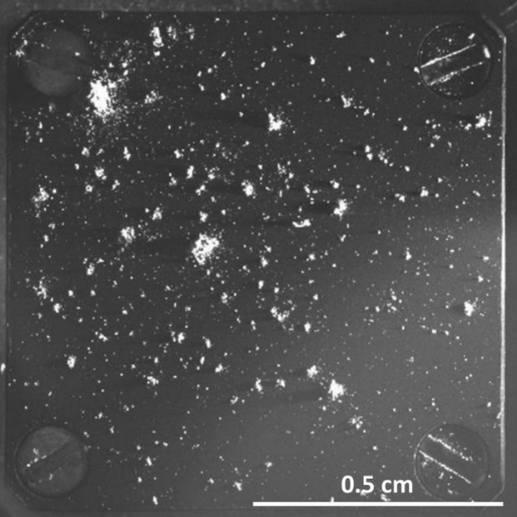
COSIMA is an instrument aboard the Rosetta spacecraft. It is led by Germany (MPS Göttingen) with significant French contributions to both the instrument and the science. The instrument’s mission was to collect sub-millimeter-sized dust particles ejected by the comet’s nucleus, photograph them (using the COSISCOPE microscope, for which the IAS is responsible), and then analyze a portion of them using time-of-flight secondary ion mass spectrometry (TOF-SIMS). One year after demonstrating that the comet’s dust contained carbonaceous material with a macromolecular structure, the COSIMA scientific team was able to determine the average elemental composition of this dust and thus conclude that this macromolecular carbonaceous material accounts for nearly half the mass of these cometary particles. The other half consists mainly of anhydrous silicate minerals. COSIMA measurements taken throughout the two-year Rosetta mission also show that all the dust particles analyzed have a similar composition, regardless of when they were collected, their size, or their morphology, suggesting that this is a property common to the entire cometary nucleus.
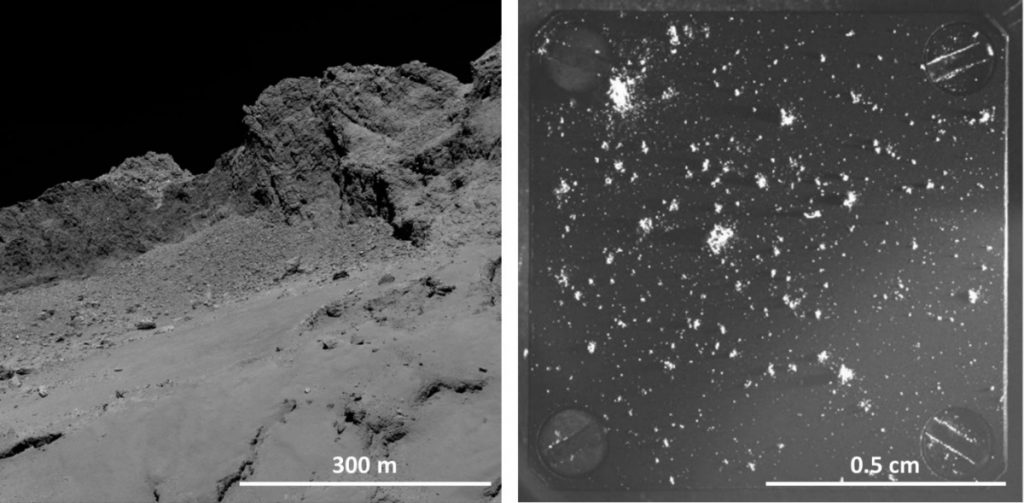
Fig. 1: On the left, the surface of the comet’s nucleus as seen by the Rosetta spacecraft. Ice condensed beneath the surface escapes from the comet’s depths as it warms upon approaching the Sun. The resulting gas emissions carry with them small particles of material that can be collected and analyzed inside the Rosetta spacecraft. On the right, an image from COSISCOPE, the microscope of the COSIMA instrument designed and built at the IAS. This photo shows a collection target (1 cm × 1 cm) with tiny fragments of the nucleus that have struck it, ranging in size up to a millimeter. Credits: left, ESA/Rosetta/MPS for the OSIRIS Team (MPS / UPD / LAM / IAA / SSO / INTA / UPM / DASP / IDA); right, ESA / Rosetta / MPS for the COSIMA Team (MPS / CSNSM / UNIBW / TUORLA / IWF / IAS / ESA / BUW / MPE / LPC2E / LCM / FMI / UTU / LISA / UOFC / vH&S.
Comets such as 67P (or, previously, Halley’s Comet) are therefore among the most carbon-rich objects in the Solar System. The results obtained from COSIMA measurements show a carbon-to-silicon (C/Si) abundance ratio very close to the solar ratio and indicate the absence of significant hydration in the mineral phases. This information points to the comet’s primitive nature. It has preserved, virtually intact, the material that accreted to form it. Comets are thus indeed a kind of preserved record of the early history of our Solar System.
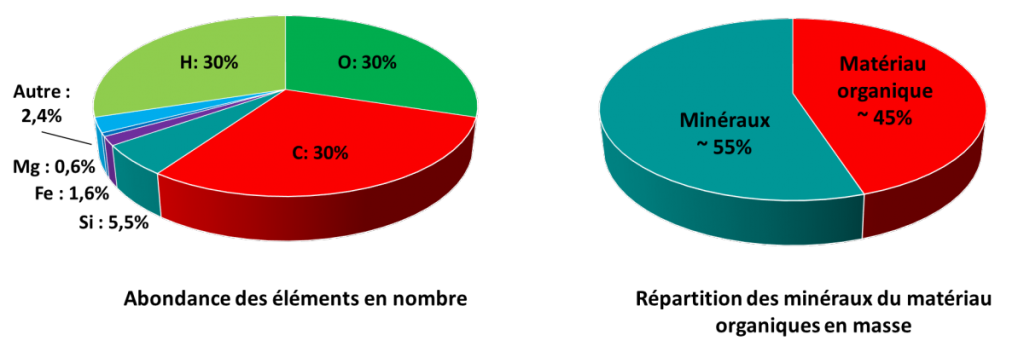
Fig. 2: Left: The average elemental composition of dust particles from Comet 67P. Right: The average mass distribution of minerals and organic material in these dust particles. Credits: ESA / Rosetta / MPS for COSIMA Team MPS / CSNSM / UNIBW / TUORLA / IWF / IAS / ESA / BUW / MPE / LPC2E / LCM / FMI / UTU / LISA / UOFC / vH&S.
Furthermore, beyond the great molecular diversity observed in the organic matter detected in the gaseous phase, these gases and the sublimated ices from which they originate represent only a very small fraction of the total cometary material. The bulk of the cometary material consists of an intimate mixture of minerals and semi-refractory carbonaceous material, which is measured in the dust. Thus, COSIMA’s results show that most of the organic matter in Comet 67P exists in the form of macromolecular carbonaceous material. Consequently, if comets played a role in the emergence of life on our planet—in particular by delivering carbon-rich material—it was primarily in this complex macromolecular form that it was brought here. This finding is consistent with laboratory analyses of extraterrestrial samples collected on Earth (meteorites, micrometeorites, and interplanetary dust particles), even though the carbon-bearing components of these samples were likely partially altered by atmospheric reentry.
Contacts
Donia Baklouti, Associate Professor, Astrochemistry & Origins Team
References
Bardyn A., Baklouti D., Cottin H., Fray N., Briois C., Paquette J., Stenzel O., Engrand C., Fischer H., Hornung K., Isnard R., Langevin Y., Lehto H., Le Roy L., Ligier N., Merouane S., Modica P., Orthous-Daunay F.-R., Rynö J., Schulz R., Silén J., Thirkell L., Varmuza K., Zaprudin B., Kissel J., and Hilchenbach M. (2017). Carbon-rich dust in Comet 67P/Churyumov-Gerasimenko measured by COSIMA/Rosetta. Month. Not. Roy. Astr. Soc. 469, S712. DOI:10.1093/mnras/stx2640
CNRS Press Release: http://www2.cnrs.fr/presse/communique/5341.htm
News from the University of Paris-Sud: http://www.actu.u-psud.fr/fr/recherche/actualites-2017/rosetta-livre-de-…