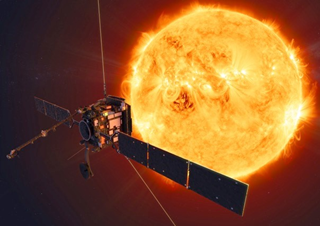
Artist's rendering of Solar Orbiter. Credit: ESA / ATG medialab
Solar Orbiter
Solar Orbiter is a mission dedicated to solar physics and the heliosphere. It was selected as the M1 mission of ESA’s Cosmic Vision program. The launch is scheduled for 2020.
Solar Orbiter will be the first satellite to explore the inner regions of our solar system, track active regions, and provide a close-up view of the Sun's polar regions.
SPICE is one of the 10 instruments aboard ESA’s Solar Orbiter mission, which will help us understand how the Sun’s activity changes over its cycles and the resulting changes in the solar wind—the stream of charged particles ejected from the Sun and traveling through the solar system.
The Role of the IAS
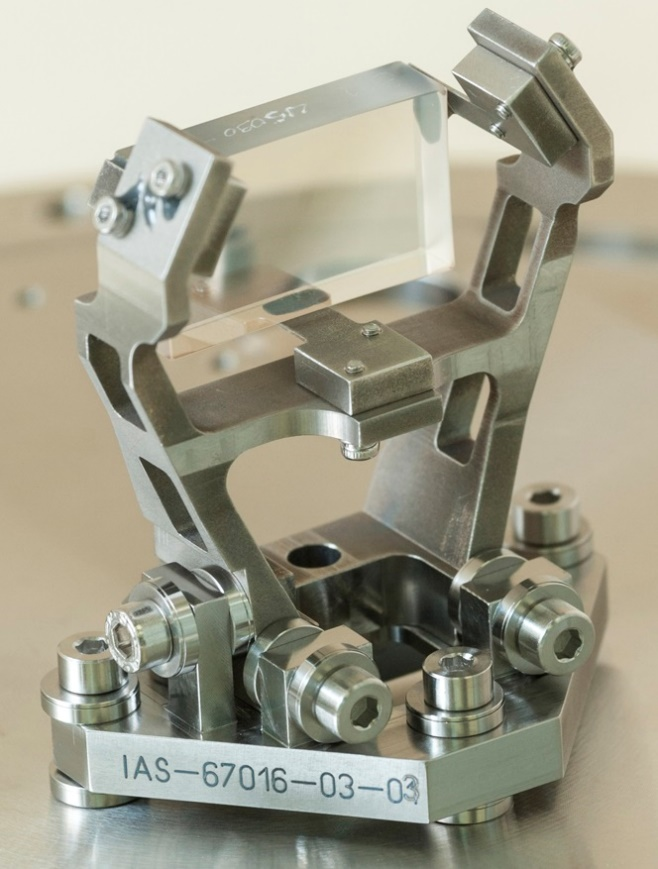
The IAS team provided the SPICE diffraction grating and is responsible for the instrument's operations.
As the successor to SOHO, this ESA mission—just like SOHO—has seen a significant commitment from the team right from the design and development phases, resulting in a co-PI (EUI instrument—Extreme Ultraviolet Imager), a lead co-I (PHI instrument—Polarimetric and Helioseismic Imager), and responsibility for the scientific operations of the SPICE instrument after launch, all handled by the Solar Physics and Planetary Systems team.
The official website of the SPICE consortium can be found here: https://spice.ias.u-psud.fr
SPICE_Solar Orbiter_ESA-NASA-Gabriel_Pelouze-IAS
Contacts
Advisors (scientific and technical)
- Frédéric Auchère, Director of the IAS, Solar and Stellar Physics Group
- Thierry Appourchaux, Solar and Stellar Physics
- ÉricBuchlin, Team Coordinator, Solar and Stellar Physics Team
For more information:
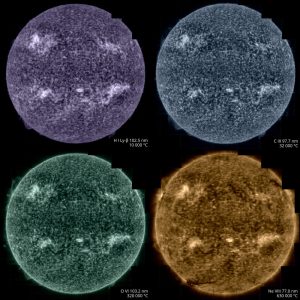
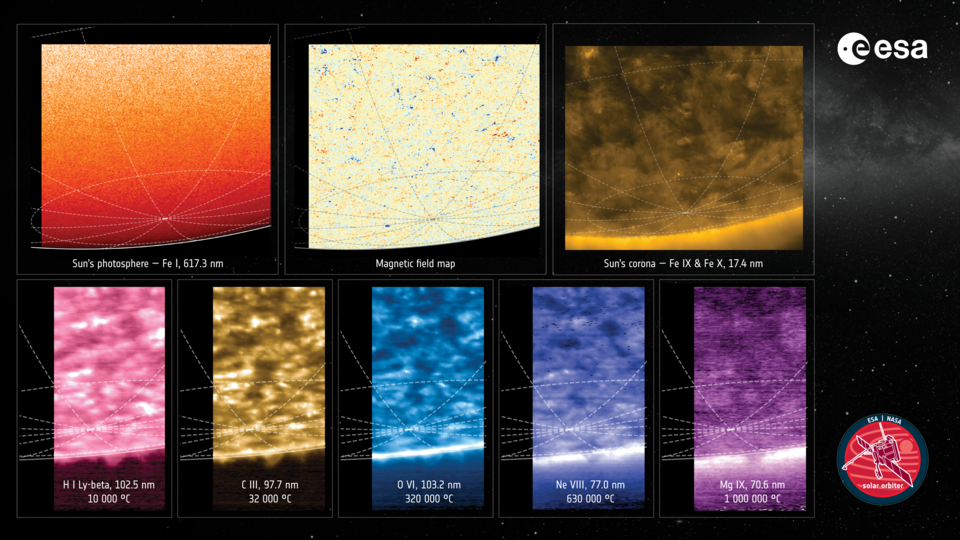
The instrument was powered on on February 24, 2020, by the SPICE team at RAL Space (United Kingdom). Over a four-week period, all mechanisms were tested, the high voltage for the detectors was activated, and finally, the detector door and the two outer doors were opened. It was when these doors were opened that the SPICE telescope was flooded with sunlight for the first time, allowing the first spectra of our star to be obtained on April 21.
Complete spectra were obtained in both SPICE wavelength bands, using all four slits and various exposure times, in order to verify the full range of the spectrometer's capabilities.
The observed spectral lines are emitted in the extreme ultraviolet by ions of various elements (hydrogen, carbon, oxygen, neon, sulfur, magnesium, and iron) and will provide information on the temperatures, densities, velocities, and composition of the plasma in the Sun’s lower atmosphere.
"SPICE is performing as expected—a great success for the entire international team led by RAL Space."
Dr. Fludra, of RAL Space and head of the instrument consortium
On April 21, 2020, the SPICE instrument aboard ESA’s Solar Orbiter mission successfully obtained its first measurements of the Sun. This is a major milestone for the instrument and for the mission, which was launched on February 10, 2020, and is currently en route to study the Sun up close.
Solar Orbiter Poles – ESA