ROSEBUD

ROSEBUD is a direct dark matter detection experiment located in the Canfranc Tunnel (Pyrenees).

Definition:Rare Object SEarch with Bolometers UndergrounD

Scientific objective:

Direct Detection of Dark Matter in the Galactic Halo

Description:    

ROSEBUD is a direct dark matter detection experiment installed in the Canfranc Tunnel (Pyrenees), in collaboration with the Department of Nuclear and High-Energy Physics at the University of Zaragoza (Spain). The detectors used are massive bolometers (50 g –> 200 g) cooled to 20 mK, which allows for the detection of energy diaphs in the range of a few keV. Due to this sensitivity and the very low expected event rate, the experiment is conducted underground to shield it from cosmic radiation. The hybrid technique developed at the IAS for scintillating bolometers should then make it possible to extract the valid events—an atom in the detector struck by a dark matter particle—from the background of events associated with the experiment’s residual radioactivity.

The Role of the IAS

Design and fabrication of detectors; cryogenics and testing at 20 mK; calibrations; analysis; data interpretation.

Archived

  • 2003: Development of the scintillation bolometer (assembled by Jacques Leblanc and Jacques de Marcillac).
  • 2006: Implementation of a technique to filter out background radiation.
  • Location: Canfranc Tunnel (Pyrenees), in collaboration withthe University of Zaragoza (Spain).

  • Technology:

    • Scintillation bolometers: Detectors cooled to 20 mK for extreme sensitivity.
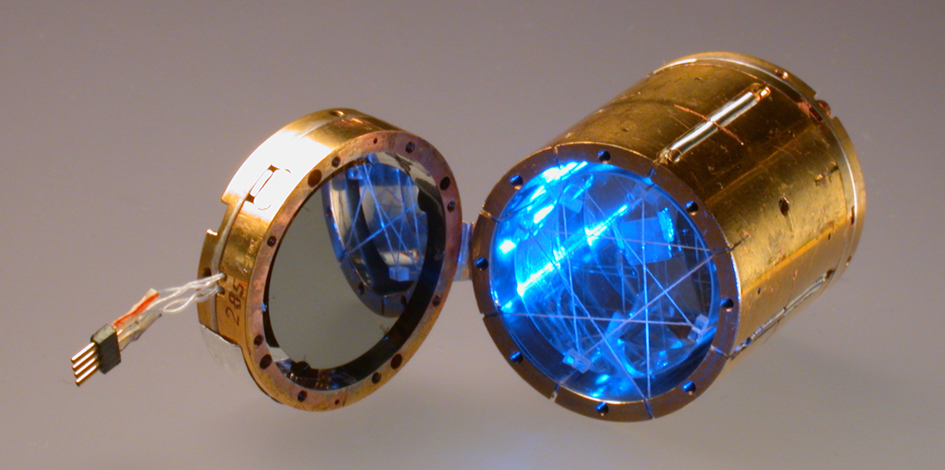
    • Dual detection: Measurement oftemperature rise and emitted light (blue scintillation from bismuth germanate (BGO) crystal) to identify the nature of the incident particles.
  • Protection Against Interference: An underground experiment to shield against cosmic radiation.

Contacts

Advisors (scientific and technical)

  • Noël Coron
  • Pierre de Marcillac
  • Thierry Redon

For more information:

Reference: ROSEBUD – SISSA.

Figure: A 92g BGO scintillation bolometer built at the IAS with its germanium optical detector. When irradiated, the bismuth germanate crystal emits a blue light; the intensity of this light, combined with a measurement of the resulting temperature rise, allows the nature of the incident particle to be identified. This property will be used to subtract the ambient radioactive background from the ROSEBUD experiment in 2006. [Assembled by Jacques Leblanc & Jacques de Marcillac; 2003]

Scroll up