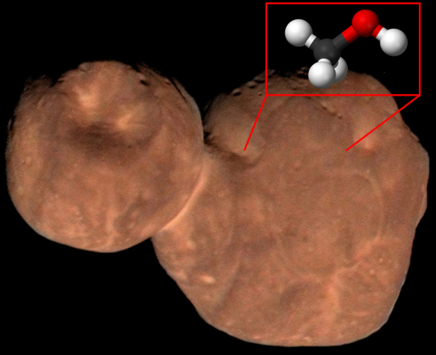
Arrokoth, a small icy body in the Kuiper Belt, was discovered in 2014 using the Hubble Space Telescope. It was selected by the New Horizons team (NASA) as the target for its extended mission in the outer solar system, following the flyby of Pluto. Arrokoth thus became the most distant object ever studied by a space probe. From an altitude of 3,500 km, the instruments onboard the probe acquired images and spectra that notably highlighted the presence of methanol ice. This compound had previously been detected on other outer solar system objects, such as the centaur 5145 Pholus and the trans-Neptunian object (55638) 2002 VE95.
These objects share another characteristic: their surface is red! This surface "reddening" can be explained by the presence of semi-refractory organic matter mixed with the ice. This organic matter is either inherited as-is from the pre-solar cloud or protoplanetary disk, or produced on the surface of the object following long-term exposure to cosmic rays and/or solar energetic particles (SEPs).
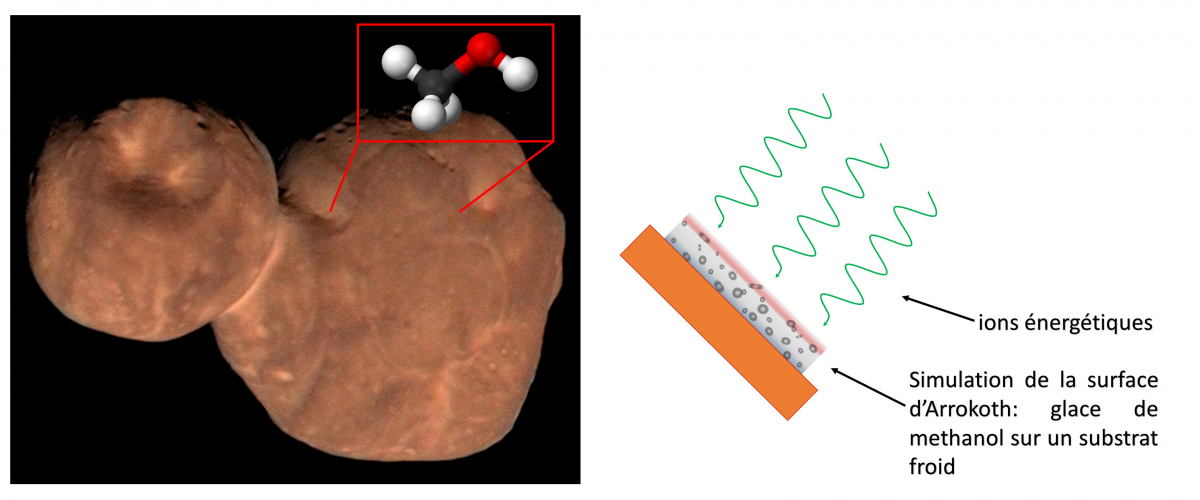
To clarify this, the IAS team utilized the INGMAR-T facility (IAS/CSNSM) coupled with the SIDONIE ion accelerator (CSNSM) to experimentally reproduce the irradiation conditions of the surface of Arrokoth and other methanol-ice-rich objects (Fig. 1). The analysis of the experimental post-irradiation infrared spectra and their comparison with astronomical and space observations made it possible to estimate the exposure time to ion irradiation for these methanol-rich surfaces, depending on their respective orbits.
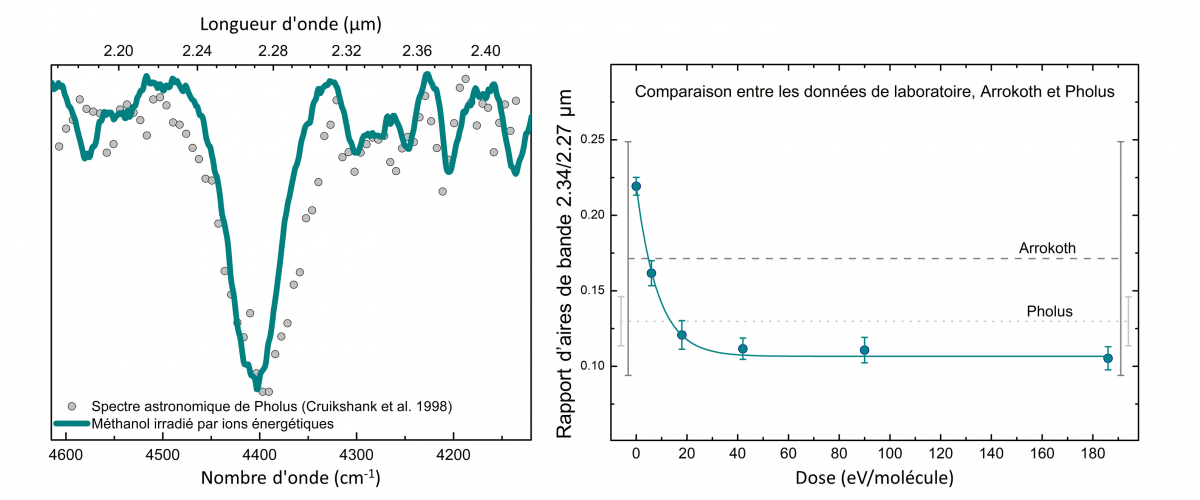
First, examination of the infrared spectra indicates that the surface of Pholus exhibits clear signs of exposure to energetic particles (Fig. 2), unlike the surface of Arrokoth. The study further reveals that among the various populations of energetic particles present in space, SEPs are primarily responsible for the alteration of the surface of these icy bodies and, consequently, their "reddening." These particles are emitted by solar active regions and solar flares. Given that the effect of SEPs decreases with heliocentric distance, Arrokoth, which is located further from the Sun than Pholus, is less affected by SEPs than the latter. This implies that to observe similar surface modifications, approximately 6 million years are required on Pholus and about 30 million years on Arrokoth.
Future astronomical observations by the James Webb Space Telescope will yield more detailed data on these objects. The results obtained at the IAS will then be useful for interpreting these new observations and determining the chemical composition and evolution of outer solar system objects.