
Planck and BICEP2/Keck Collaboration: Upper limit on the amplitude of primordial gravitational waves
By jointly analyzing their data, the Planck and BICEP2/Keck collaborations have demonstrated that primordial gravitational waves have not yet been detected through the observation of the cosmic microwave background polarization. This result marks the conclusion of a scientific saga that has captivated cosmologists and space enthusiasts alike since March 2014: the signal whose detection was announced at the time by the BICEP2 team is not associated with the earliest moments of the Big Bang. Instead, it results from a combination of galactic emission and gravitational lensing distortions of the cosmic microwave background during its propagation to Earth.
The cosmic microwave background, the primordial radiation of the Big Bang, provides a snapshot of the Universe—now 13.8 billion years old—as it was at 380,000 years. Since its discovery exactly fifty years ago, cosmologists have continuously observed it with increasing precision to understand the origin and content of the cosmos. In recent years, the ESA's Planck satellite has measured it with unprecedented accuracy and has already delivered an exceptional array of discoveries, even though the data has not yet revealed all its secrets. The cosmic background acts as a true cosmic screen onto which traces of the primordial Universe are projected in the form of fluctuations. Observing it allows scientists to trace back to the epoch of their origin, presumably an extremely brief phase of exponential expansion known as inflation. During inflation, gravitational waves were naturally generated. Their spacetime-distorting effects subsequently left an imprint on the polarization of the cosmic microwave background. The B-modes of this polarization, specific to gravitational waves, lie at the heart of the research conducted by the Planck and BICEP2 collaborations.
March 2014 – BICEP2 detections
In March 2014, following several years of observation, the BICEP2 team, whose telescope is located at the South Pole, published a highly publicized result announcing the detection of a B-mode polarized signal in a region of the sky renowned for being largely uncontaminated by emission from our Galaxy. This signal was initially interpreted as a highly probable detection of primordial gravitational waves. However, doubt quickly arose within the scientific community because BICEP's observations provided very few constraints regarding galactic contamination. Were BICEP's B-modes not, at least partially, a galactic signal? Only the Planck team was in a position to address this question, thanks to its sky observation data at a higher emission frequency than BICEP's, where the galactic signal is dominant.
September 2014 – Planck analyzes the galactic contribution
A first piece of the puzzle was provided in September 2014 by a Planck publication showing that the polarized emission of galactic dust across the entire sky has an amplitude at least comparable to the signal measured by BICEP. Thus, no window is completely clean when searching for primordial gravitational waves. Nevertheless, this statistical result still left some uncertainty regarding the nature of the signal measured by BICEP. Was it possible to demonstrate that at least part of the signal was the sought-after cosmological signal?
January 2015 – The Planck-BICEP2/Keck collaboration bears fruit
The Planck and BICEP2 teams then joined forces to answer this question. At the heart of their collaboration: Planck's galactic signal map and the signal map measured by BICEP, supplemented by new observations obtained since March with the Keck telescope, also located at the South Pole. The comparison of the three datasets has now shown that the galactic contribution is dominant at the angular scales where the signal from primordial gravitational waves is expected.
However, a B-mode polarization of the cosmic microwave background was indeed detected... but it corresponds to the signal associated with the gravitational lensing effect exerted by the distribution of matter along the path traveled by light to reach us. This signal is distinguished from that of primordial gravitational waves by its distribution across angular scales. It should be noted that this is not the first detection of this effect, which provides insight into the distribution of matter in the Universe, but it is by far the most precise achieved to date.
Thus, after eliminating the galactic signal and the contribution of the lensing effect, the data do not allow for the unambiguous detection of the sought-after imprint of primordial gravitational waves. This does not mean that this signal does not exist! It is simply too weak to be detected with this dataset. On the other hand, the Planck/BICEP2/Keck collaboration was able to establish an upper limit on the intensity of primordial gravitational waves. This direct limit is consistent with the one obtained indirectly in 2013 by Planck alone based on temperature fluctuations of the cosmic background. This Planck result preceded the first BICEP publication. It was not considered contradictory because its interpretation depended on the cosmological model used in the data analysis. The new direct measurements show that the standard cosmological model used by Planck is quite sufficient to describe all current results.
The quest for B-modes in the cosmic microwave background is not over. It will continue with increasingly precise observations from the ground and stratospheric balloons, thanks to the rapid development of detector arrays. However, the Planck survey, at frequencies inaccessible from the ground, will long remain the essential reference for separating the cosmological and galactic components of the signal.
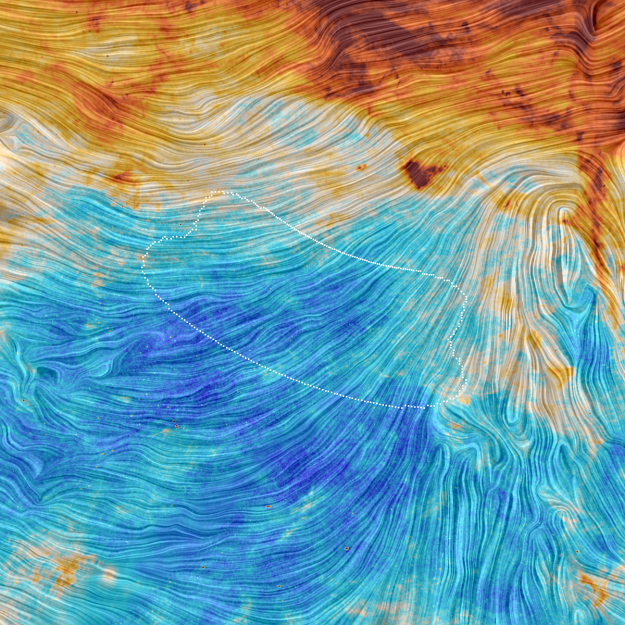
Map of dust (colors) and the galactic magnetic field (reliefs) measured by Planck at 353 GHz. BICEP2's observation field is indicated by white dashed lines. There is some dust (the area is indeed in the blues, but by no means a uniform dark blue) and clearly, the polarized emission used to trace the magnetic field lines cannot be ignored.
Credits: ESA – Planck collaboration / Image by M.-A. Miville-Deschênes, CNRS – Institut d’Astrophysique Spatiale, Université Paris-Sud, Orsay, France
Contacts
Scientific and Technical Contacts
Jean-Loup Puget, François Boulanger, Jonathan Aumont, Marc-Antoine Miville-Deschênes
Learn more:
Everything you need to know about Planck: www.planck.fr