
CIVA/Philae has observed particles that may be evidence of primordial accretion processes
Images of the nucleus of 67P/Churyumov-Gerasimenko captured by the CIVA cameras aboard Philae revealed a unique, unexpected, highly irregular landscape dominated by consolidated materials. Following a detailed analysis, the landing site surrounding Philae proved to be unique in its ability to constrain past and present conditions on the comet’s surface.
A quantitative analysis of the microscopic structures—namely fractures and grains visible at the resolution of the CIVA images (>1 mm/pixel)—was conducted and then placed within the geological context of the site, which was recently mapped by Rosetta’s OSIRIS camera (Fig. 1), confirming, at first glance, that the site is very well-preserved. The observed fractures (up to more than 10 cm in length) are interpreted as the result of variations in solar radiation leading to thermal fatigue and/or the slow sublimation of volatile materials. This surface fragmentation could generate macroscopic erosion, which is observed on a larger scale by Rosetta.
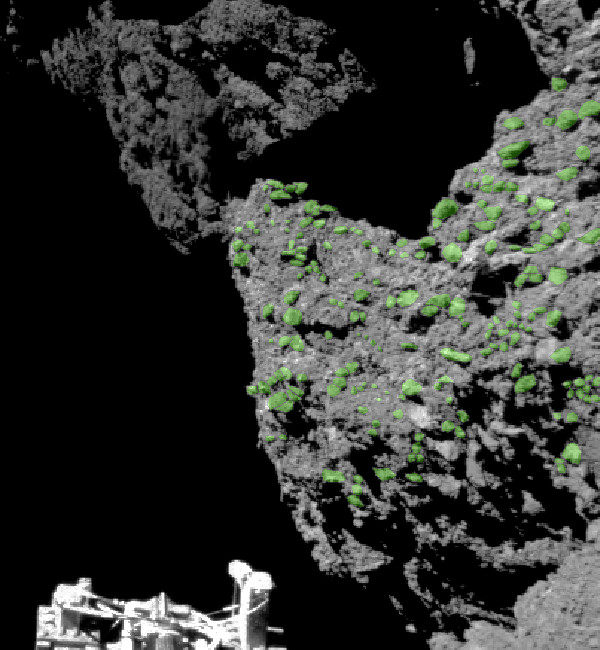
The particle size distribution resolved by CIVA (Fig. 2) differs very significantly from that of the particles present in the comet’s coma as observed by various Rosetta instruments and can hardly be explained by modern surface processes.
This leads us to suggest that these small pebbles could be remnants of the primordial accretion of the solar system. The presence of these potentially primordial grains, ranging in size from millimeters to centimeters, supports the “pebble accretion” model—a model introduced about a decade ago to resolve certain issues, such as the “1-meter barrier,” arising from the historical “coagulation” or “hierarchical” accretion model. Furthermore, the particle size constraints provided by CIVA indicate that the comet formed in the outer regions of the solar system, which is consistent with other measurements such as the D/H and N₂/CO abundance ratios. Next step? Recent OSIRIS images will enable the construction of a digital elevation model of the landing site and help refine our understanding of the CIVA images and the lander’s attitude. This work is being conducted in collaboration with LAM and CNES.
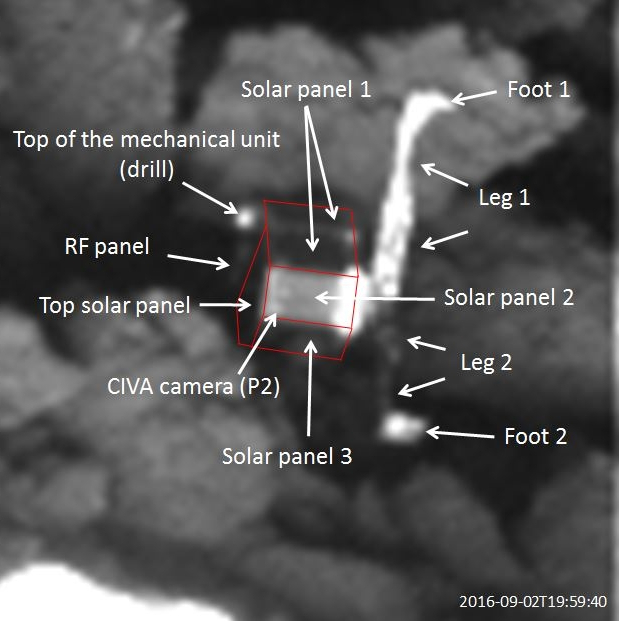
Fig. 1: Image of Philae taken on September 2, 2016, by Rosetta (CNES/SONC).
Fig. 2: A close-up of a CIVA image (Camera 3) showing the presence of particles (in green) that may indicate accretion processes in the solar system.
Contacts
François Poulet, Astronomer,Solar System and Planetary Systems Physics Team
References
Publication: Poulet et al., 2016. “Origin of the local structures at the Philae landing site and possible implications for the formation and evolution of 67P/Churyumov–Gerasimenko,” MNRAS (November 2016) 462, S23–S32. DOI: 10.1093/mnras/stw1959