
Chiral-MICMOC: At the origin of the asymmetry of biological molecules on Earth?
Living organisms utilize chiral amino acids exclusively in the L-enantiomeric form for protein synthesis, a property known as homochirality. The origin of this asymmetry remains poorly understood to this day, though a two-step process is generally accepted: first, the emergence of slight enantiomeric excesses (e.e.s) in organic chiral material, followed by an amplification mechanism leading to the complete selection of a single enantiomer.
One of the leading hypotheses proposed to explain the emergence of initial enantiomeric excesses (e.e.) involves the interaction of circularly polarized light (CPL) with matter, thereby introducing initial asymmetry. Building upon results obtained in 2011 concerning an amino acid (alanine), the interdisciplinary Chiral MICMOC (Interstellar and Cometary Matter, Complex Organic Molecules) experiment by the IAS "Astrochemistry and Origins" team has yielded new insights into this issue by extending measurements to five amino acids. These compounds exhibit identical behavior under circularly polarized UV radiation, thereby refining potential astrophysical scenarios for the origin of biomolecular asymmetry on the primitive Earth.
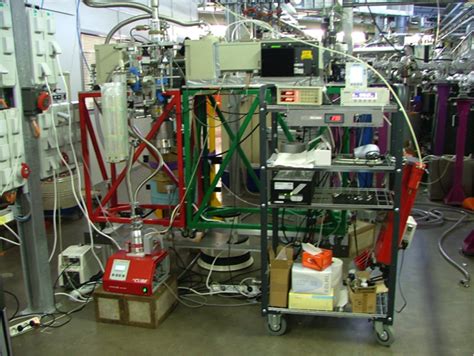
Since 2003, the "Astrochemistry and Origins" team has been conducting a photochemical simulation experiment on interstellar ice analogues, notable for utilizing an "asymmetric" light beam—specifically circularly polarized light provided by synchrotron radiation—to drive the photochemistry. Initial results successfully demonstrated enantiomeric selectivity on a proteinogenic amino acid, alanine, on the DESIRS beamline at the SOLEIL synchrotron (Figure 1). Leveraging the performance of this beamline, provided by Laurent Nahon and his team, alongside multidimensional gas chromatography coupled to time-of-flight mass spectrometry (GCxGC-TOFMS) analytical methods installed and calibrated by Uwe Meierhenrich and his team at the University of Nice (ICN, Nice), significant new results have been achieved.
Indeed, enantiomeric excesses of the same sign were measured in five amino acids: α-alanine, valine (proteinaceous); 2,3-diaminopropionic acid, 2-aminobutyric acid, and norvaline (non-proteinaceous). These excesses remain small (less than 2%) but are comparable to those observed in certain primitive meteorites, thereby supporting the astrophysical scenario leading to the source of asymmetry required by prebiotic chemistry to trigger the emergence of homochirality—a fundamental characteristic of living systems. Furthermore, the fact that these five amino acids behave identically (same-sign excesses) is critical for validating the physical hypothesis underlying the scenario: UV-CPL irradiation of inter/circumstellar ices leading not only to the formation of amino acids but also to a degree of enantiomeric enrichment.
Regarding alanine, further experiments were conducted by varying the helicity (left- and right-handed polarization) and wavelength (6.6 eV and 10.2 eV) of the photons employed. A direct correlation was observed between these parameters and the sign of the measured excesses, pointing to a circular dichroism effect as the underlying phenomenon. Furthermore, excesses of the same sign were obtained by irradiating exclusively the ices or solely the organic residue recovered at room temperature. This finding first indicates the formation of chiral species within the ice phase, which serve as precursors to the amino acids contained in the final organic residue; these species could potentially exist within molecular clouds and subsequently be incorporated into meteorite parent bodies.
The astrophysical application rests on a plausible scenario: on one hand, the laboratory ice analogues closely mirror the chemical composition of interstellar and circumstellar ices; on the other hand, intense UV-CPL sources yielding up to 22% circular polarization rates have been identified in massive star-forming regions within the Orion nebula and NGC 6334. The spatial extent of a single helicity (right or left) significantly exceeds (by a factor greater than 100) the dimensions of a forming "solar system," thereby effectively ensuring a uniform enantiomeric excess—specifically the L-form for amino acids—across our entire Solar System.
Consequently, this laboratory astrophysics experiment could validate the long-standing hypothesis that the enantiomeric selection of biological molecules, first observed by Pasteur in 1848, stems from a deterministic physical origin, a concept previously discussed by Pierre Curie in 1897.
Finally, an indirect implication of this result suggests that the solar nebula likely originated in a massive star-forming region. This hypothesis has been considered for three decades and is reinforced by the detection of extinct radioactivities in primitive meteorites, resulting from the supernova explosions of massive stars.
This experimental work is now ongoing, targeting other key prebiotic molecules whose biological homochirality (D) is the opposite of that found in amino acids (L): sugars.
References
Modica, P. et al., ApJ 788, 79 (2014)