
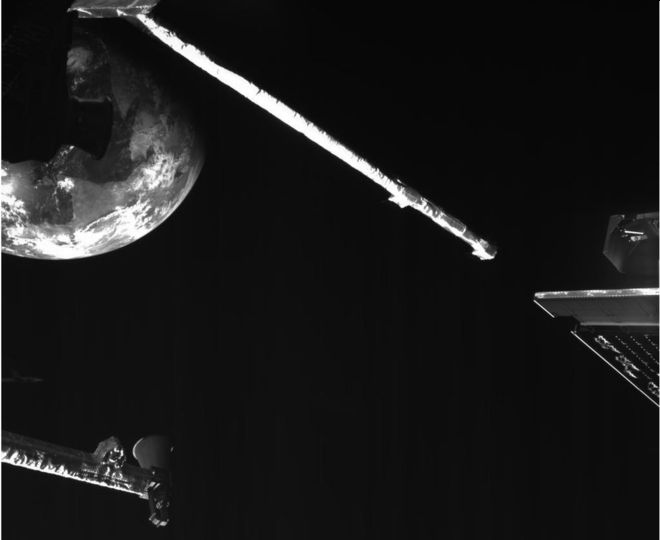
A year and a half after its launch in October 2018, the BepiColombo spacecraft performed an Earth flyby on April 10, 2020. This flyby allows it to head toward Venus, with the goal of entering orbit around Mercury in late 2025. BepiColombo is the first European mission to use ion propulsion, which allows for significant changes in trajectory with a low mass ejection.
This ambitious mission will study the planet closest to the Sun using two polar orbiters. One orbiter, under European leadership, will operate at an altitude between 400 km and 1,500 km to study the planet’s surface and interior. The other orbiter, under Japanese leadership, will follow an elliptical orbit reaching altitudes of over 10,000 km to study Mercury’s environment, which interacts strongly with the planet’s surface since Mercury has no atmosphere. The IAS is responsible for the electronics module and onboard software of the Simbio-Sys instrument suite—under Italian scientific leadership—which will generate more than 50% of the European orbiter’s data.
Contacts at the IAS, Solar System and Planetary Systems Physics Team: Mathieu Vincendon, Yves Langevin, François Poulet