
Have we discovered the hidden matter of the universe?
Astrophysicists estimate that nearly 40% of the ordinary matter that makes up stars, planets, and galaxies remains unobserved, hidden in the form of hot gas within the intricacies of the cosmic web. Scientists at the IAS may have detected this hidden matter for the first time through an innovative statistical analysis of data collected over the past 20 years.
Galaxies are distributed throughout the universe in the form of a complex network of nodes connected by filaments, which are themselves separated by voids. This is known as the cosmic web. Its filaments are thought to contain nearly all of the ordinary matter—known as baryonic matter—in the form of a diffuse, hot gas. But because the signal from this sparse phase of gas is so weak, in practice, 40 to 50% of the baryons¹ are missing.
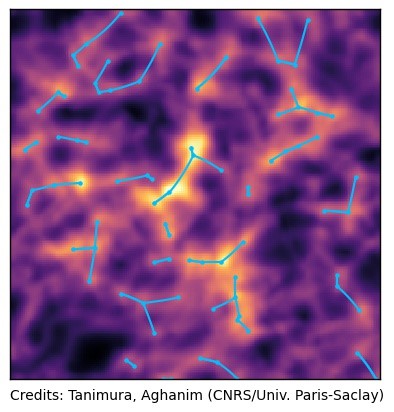
It is these missing baryons, hidden within the filamentary structure of the cosmic web, that Nabila Aghanim, a CNRS researcher at the IAS, Hideki Tanimura, her postdoctoral fellow, and their colleagues are tracking. In a new study, funded by the ERC ByoPiC project, they report a statistical analysis that reveals, for the first time, X-ray emission from hot baryons populating the filaments. This result is based on the stacking of X-ray signals from the ROSAT² survey of approximately 15,000 large cosmic filaments identified in the SDSS³ galaxy survey. The team thus took advantage of the spatial coincidence between the positions of the filaments and the associated X-ray emission to provide tangible evidence of the presence of hot gas in the cosmic web and to measure its temperature for the first time.
This result supports previous analyses by the same research team, based on indirect detections of hot gas in the cosmic web through its effect on the cosmic microwave background⁴. It paves the way for more detailed studies that will use higher-quality data to test the evolution of gas within the filamentary structure of the cosmic web.
Figure: Simulated image of the X-ray emission from the gas contained within the filaments of the cosmic web
Contacts
Advisors (scientific and technical)
- Nabila Aghanim, Research Director, ECosmology Team
- Hideki Tanimura
References
CNRS Press Release: https://www.cnrs.fr/fr/aurait-decouvert-la-matiere-cachee-de-lunivers
Scientific article: First statistical detection of X-ray emission from cosmic-web filaments. Tanimura, H.; Aghanim, N.; Kolodzig, A.; Malavasi, N.; Douspis, M. (2020). A&A, 643, L2. doi: 10.1051/0004-6361/202038521
Notes:
¹ Baryons are particles composed of three quarks, such as protons and neutrons. They make up atoms and molecules, as well as all visible structures in the observable universe (stars, galaxies, galaxy clusters, etc.). The “missing” baryons, which have not been observed until now, are distinct from dark matter, which is composed of non-baryonic matter of unknown nature.
² ROSAT is a German space telescope designed for X-ray observation.
³ The Sloan Digital Sky Survey (SDSS) is a program for surveying celestial objects using a dedicated 2.5-meter-diameter optical telescope located at the Apache Point Observatory (New Mexico, United States). It began in 2000.
⁴ See the article: “Density and temperature of cosmic-web filaments on scales of tens of megaparsecs,” Tanimura, H.; Aghanim, N.; Bonjean, V.; Malavasi, N.; Douspis, M. *Astronomy & Astrophysics*, Volume 637, A41 (2020).