This mission is entirely dedicated to studying the atmospheres of exoplanets: approximately one thousand exoplanets will be scrutinized over a 4-year period. A successful battery of tests for the AIRS instrument. The development of space equipment requires various intermediate models to progressively validate mechanical, thermal, electrical, or software design. For example, Structural and Thermal Models (STMs) allow for the validation of mechanical and thermal design, while Avionics Models (AVMs) and subsequently Engineering Models (EMs) allow for complete electrical and functional validation. The flight model is then built based on these results, or alternatively on a qualification model incorporating all of the equipment's functions. As part of the development of the AIRS instrument—and specifically the cold section of the spectrometer—the engineering model was conceived as a qualification model with the objective of fully validating its design, particularly regarding the space environment requirements of the ARIEL mission, both mechanical and thermal. In conjunction with these tests, a long calibration campaign began in March 2026 to measure the instrument's performance, notably featuring the acquisition of the spectrometer's first image.
The AIRS instrument consists of an ADCU (AIRS Detector Control Unit) electronic box and the cold section, the spectrometer's CU (Cold Unit), which includes two optical benches associated with two focal planes to cover the wavelength range from 1.95 to 7.8 microns. CEA develops the detection chains for the detectors assembled on a focal plane up to the complete ADCU control unit. IAS is responsible for the two optical benches, their integration and alignment, as well as the measurement of physical and vibrational properties.
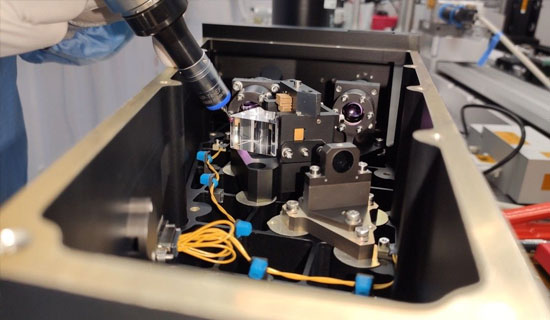
The optical benches are composed of several subsystems (lenses, prisms) held by mechanical mounts. These subsystems are assembled and tested at IAS, where it is verified that they exhibit the expected optical characteristics and will withstand launch loads.
Once the optical benches are assembled and aligned, the focal planes are mounted onto them. All assemblies are performed in a cleanroom to ensure there is no dust on the optics or contamination that could degrade instrument performance.
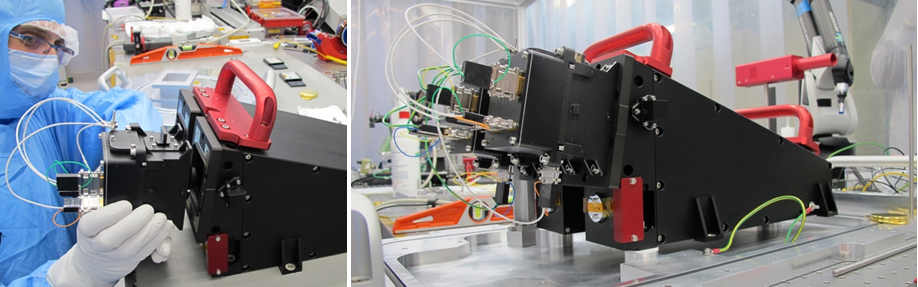
Once everything has been assembled—optical benches + focal planes—we proceed to vibration testing on the IAS shaker table. We then verify the structural integrity of the instrument, as well as the relative alignment of the two optical benches to ensure no deformations occurred during these tests.
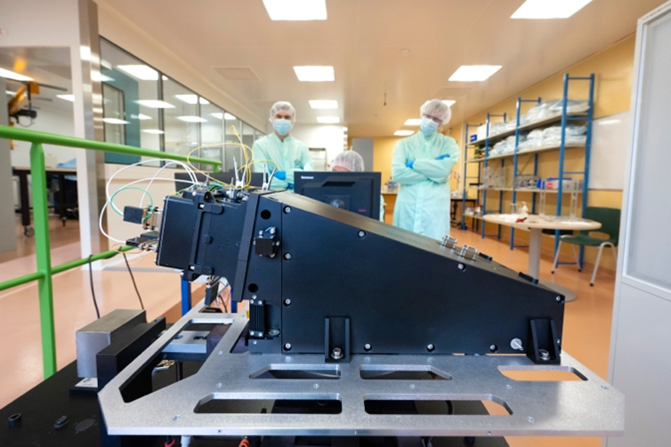
The cold section is subsequently sent to LIRA for thermal testing and instrument calibration. The engineering model of the AIRS infrared spectrometer has been installed since March 2026 at LIRA within MESPAL's SimEnOm cryogenic vacuum chamber, a vessel designed to reproduce space-like conditions and verify the proper functioning of the instrument. LIRA is responsible for this entire testing campaign, providing the equipment—including an optical bench that simulates the telescope—and conducting all measurements to evaluate instrument performance.
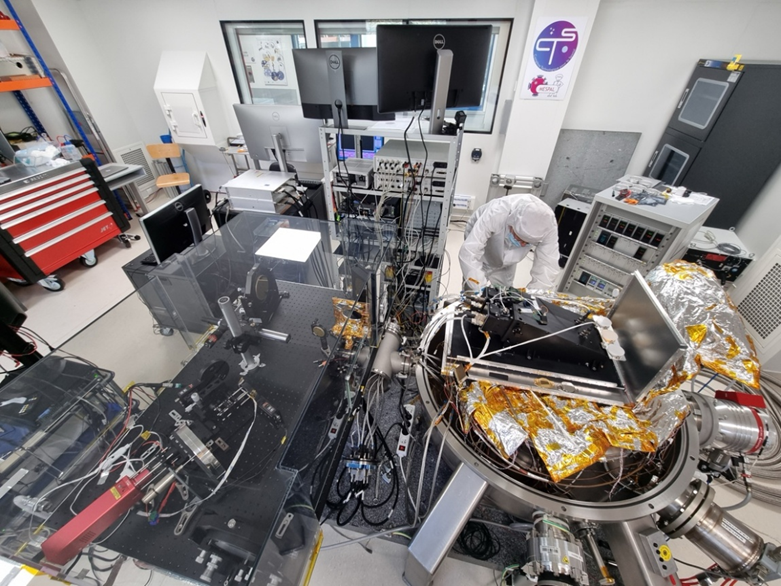
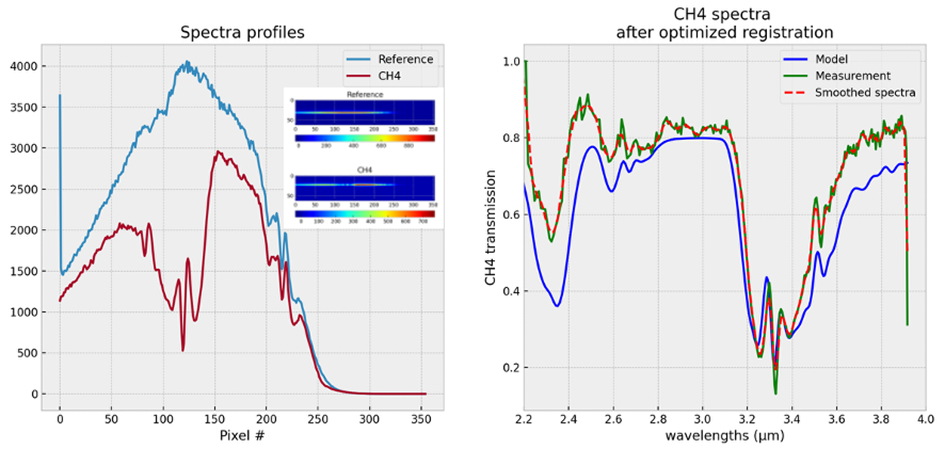
These tests will run until November 2026, with the participation of scientific teams from CEA, IAS, and IAP. Once this phase is complete, the instrument will be delivered to the Rutherford Appleton Laboratory (RAL) in the United Kingdom for further testing with all integrated systems on the ARIEL payload. Another milestone reached for AIRS. Recently, to verify the performance of the AIRS instrument, a measurement was conducted through a cell containing gaseous methane. Methane is an organic compound present in Earth's atmosphere that is also expected to be detected on exoplanets observed with ARIEL. The positions of the methane spectral lines are precisely known, making it possible to verify that the instrument responds nominally upon detection.
The measurement procedure is straightforward. It consists of two acquisitions performed with AIRS: the first with methane, and the second without methane, which serves as a reference. By taking the ratio of the two measurements, the methane spectrum obtained with AIRS can be compared against a theoretical model. The figure below shows the raw spectra of the reference and the methane cell measurement on the left, and the comparison between the measured spectrum and the theoretical model on the right. The excellent correlation between the two suggests nominal instrument performance.