This mission is entirely dedicated to studying the atmospheres of exoplanets: over the course of four years, approximately 1,000 exoplanets will be scrutinized. The AIRS instrument has successfully passed a series of tests. The development of space equipment requires various intermediate models to progressively validate the mechanical, thermal, electrical, and software designs. Structural and Thermal Models (STM), for example, enable the validation of the mechanical and thermal design, while Avionics Models (AVM) and Engineering Models (EM) enable complete electrical and functional validation. The flight model is then built based on these results, or on the basis of a qualification model that incorporates all of the equipment’s functions.As part of the development of the AIRS instrument—and specifically the cold section of the spectrometer—the engineering model was designed as a qualification model with the goal of fully validating its design, particularly with regard to the ARIEL mission’s space environment requirements, whether mechanical or thermal. In conjunction with these tests, an extensive calibration campaign began in March 2026 to measure the instrument’s performance, notably including the acquisition of the spectrometer’s first image.
The AIRS instrument consists of an ADCU (AIRS Detector Control Unit) electronics box and the cold unit ( CU ) of the spectrometer, which includes two optical benches associated with two focal planes to cover the wavelength range from 1.95 to 7.8 microns. The CEA develops the detection chains for the detectors assembled on a focal plane, all the way up to the complete ADCU control unit. The IAS is responsible for the two optical benches, their integration and alignment, as well as measurements of physical properties and vibrations.
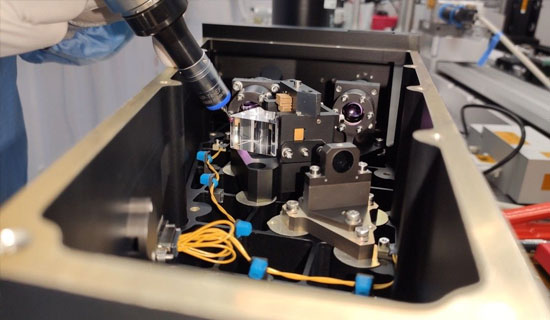
The optical benches consist of several subsystems (lenses, prisms) held in place by mechanical mounts. These subsystems are assembled and tested at the IAS, where it is verified that they possess the expected optical characteristics and can withstand the stresses of launch.
Once the optical benches are assembled and aligned, the focal planes are mounted onto them. All assembly is performed in a cleanroom to ensure that there is no dust on the optics or any contamination that could degrade the instrument’s performance.
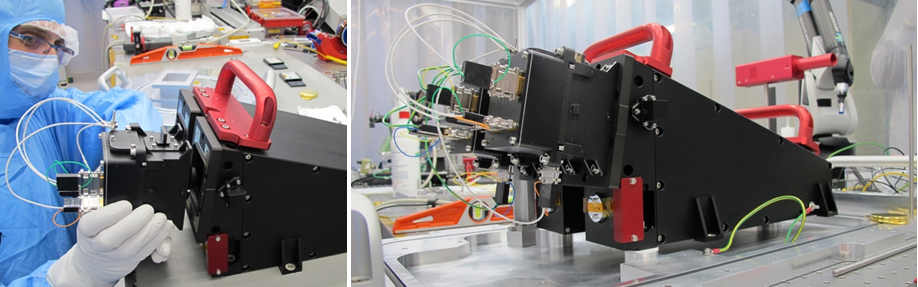
Once everything has been assembled—optical benches and focal planes—we move on to vibration testing on the IAS vibration table. Then, we check the instrument’s integrity, as well as the alignment of the two optical benches relative to each other, to ensure that no distortions occurred during these tests.
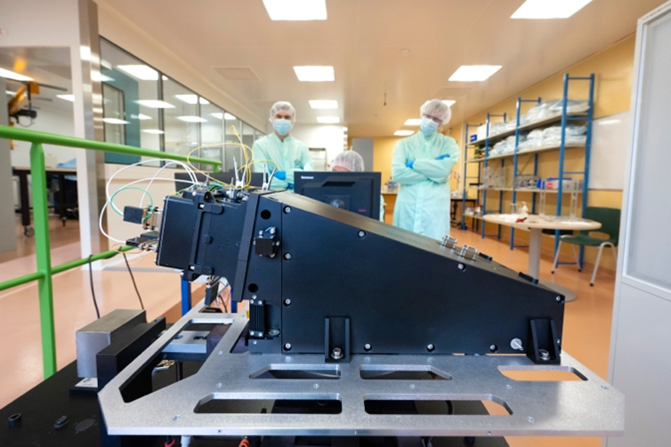
The cold end is then sent to LIRA for thermal testing and instrument calibration. The engineering model of the AIRS infrared spectrometer has been installed at LIRA since March 2026 in MESPAL’s SimEnOm cryogenic vacuum chamber, a chamber designed to replicate conditions similar to those in space and to verify the instrument’s proper functioning.LIRA is responsible for this entire test campaign: it provides the equipment—including an optical bench that simulates the telescope—and performs all the measurements to evaluate the instrument’s performance.
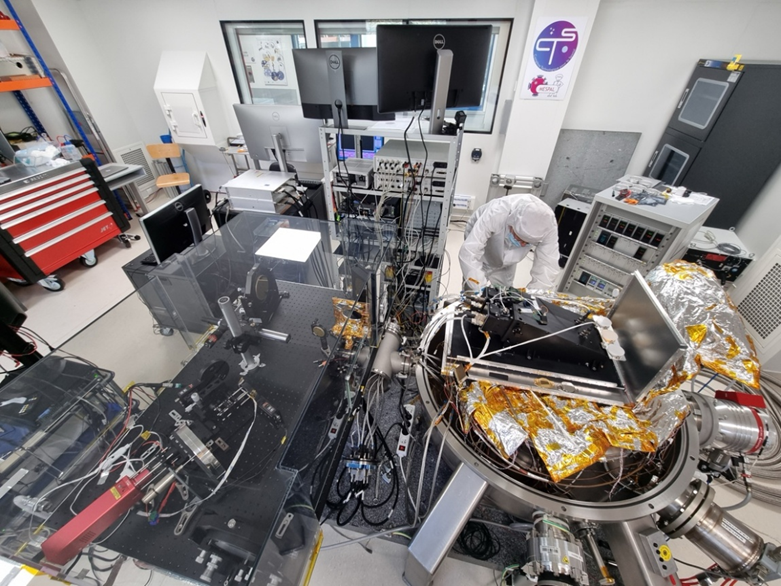
These tests will continue through November 2026, with the participation of scientific teams from the CEA, the IAS, and the IAP. Once this phase is complete, the instrument will be delivered to the Rutherford Appleton Laboratory (RAL) in the United Kingdom for additional testing with all the systems integrated into the ARIEL payload. Another milestone for AIRS. Recently , to verify the performance of the AIRS instrument, a measurement was taken through a cell containing gaseous methane. Methane is an organic compound present in Earth’s atmosphere that is expected to be found on exoplanets observed with ARIEL.The positions of methane’s spectral lines are precisely known and allow us to verify that the instrument responds as expected when it detects them.
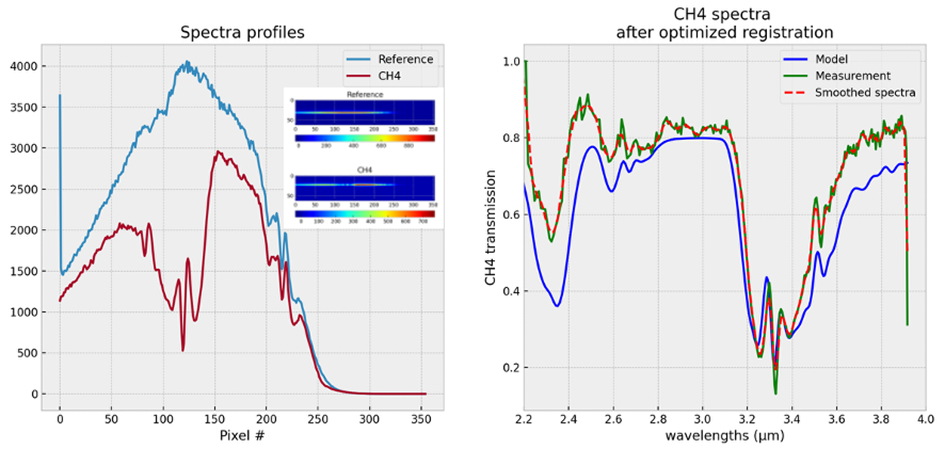
The measurement is very simple. It involves taking two acquisitions with AIRS: the first with methane, and the second without methane, which serves as a reference. By calculating the ratio of the two measurements, we can compare the methane spectrum obtained with AIRS to a theoretical model. The figure below shows, on the left, the raw spectra of the reference and the methane cell measurement, and on the right, the comparison between the measured spectrum and the theoretical model. The excellent correlation between the two suggests that the instrument is performing as intended.