
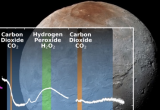
A study in which IAS participated has just revealed the presence of new molecules on the surface of Charon, Pluto's largest moon, thanks to observations from the James Webb Space Telescope (JWST). While a NASA mission, New Horizons, had already mapped this moon in 2015, recent observations by JWST have detected carbon dioxide and hydrogen peroxide on its surface for the first time, enriching our understanding of its chemical composition.
You are here
Congratulations to Marion Zannese on winning the Prix Jeunes Talents France For Women In Science 2024 from the L'Oréal-UNESCO Foundation!
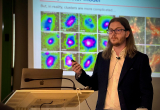
Marion Zannese, who defended her thesis on 26 September entitled ‘High excitation of molecules in irradiated regions of star and planetary formation observed with the James Webb Space Telescope’, under the supervision of Émilie Habart and Benoit Tabone, is now a post-doctoral fellow at the IAS, where she will continue her work on the study of irradiated regions of star and planetary formation with the JWST.
Hydrated Ammonium-Magnesium-Phosphorus-rich compounds (“HAMP”) have been discovered in the samples from the Ryugu asteroid. Embedded within an organic-rich phyllosilicate matrix, they may have been a key source of phosphorus and nitrogen necessary for the start of prebiotic chemistry on the primitive Earth.
Stefano Gallo, Cosmology team, defended his thesis entitled ‘On Galaxy Cluster modelling in the context of Cosmological analyses’, under the supervision of Nabila Aghanim and Marian Douspis. He is now a new doctor at the Université Paris-Saclay, and will be heading for Germany. Congratulations to him!
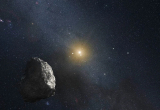
A large observing program of the James Webb Space Telescope has recently provided the first comprehensive view of Trans-Neptunian Objects (TNOs), the small primitive bodies of the outer solar system, orbiting beyond Neptune, from which some comets originate. Observations of 59 objects obtained with the NIRSpec instrument have been analyzed by an international research team involving the Institut d'Astrophysique Spatiale. The infrared spectra reveal the first-ever detections of CO₂ and CO ices on small bodies in the outer solar system.