
On the occasion of its thirtieth anniversary, the Institut d'Astrophysique Spatiale (IAS - CNRS, Université Paris-Saclay) wished to highlight its activities and the know-how of its staff, in the form of a film lasting just over an hour, directed by Frédéric Hullin, a video maker from the Université Paris-Saclay.
You are here
Congratulations to Cydalise Dumesnil who has been awarded the CNRS Crystal Medal for the quality and originality of her work!
This distinction rewards engineers and technicians who, through their technical expertise and creativity, contribute, alongside researchers, to the advancement of knowledge, to the influence of the CNRS and to the excellence of French research.
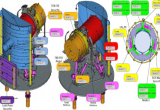
The PLATO project has reached a new stage in the development at IAS of the calibration structure for the flight cameras. The validation tests of the installations started at the beginning of March, on cryogenic vacuum infrastructures deployed in the Saturn thermal chamber, at the IAS calibration station. All the tests have just been successfully completed.
The IDOC (Integrated Operation and Data Center) platform at IAS has just assigned DOIs for 83 numerical codes and datasets it hosts. A DOI (Digital Object Identifier) is a character string that uniquely and permanently identifies an electronic resource.
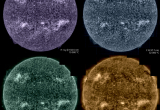
Solar Orbiter’s latest images shows the full Sun in unprecedented detail. They were taken on 7 March, at a distance of roughly 75 million kilometres, half way between the Earth and Sun. One of the images, taken by the Extreme Ultraviolet Imager (EUI) is the highest resolution image of the Sun’s full disc and outer atmosphere, the corona, ever taken. Another image, taken by the Spectral Imaging of the Coronal Environment (SPICE) instrument, represents the first full Sun image of its kind in 50 years, and by far the best one, taken at the Lyman-beta wavelength of ultraviolet light that is emitted by hydrogen gas.