
Solar and Stellar Physics
Overview
The Solar and Stellar Physics team aims to provide insights into some key questions in solar and stellar physics, such as the process of coronal heating and the structure of the solar and stellar interiors. Since the magnetic field plays a fundamental role in shaping the atmospheres of solar-type stars, it is becoming possible to better understand the coupling between the internal generation of the magnetic field and its external manifestations. The two main themes are therefore: the dynamics and internal structure of the Sun and stars and the diagnosis and heating of the outer layers.
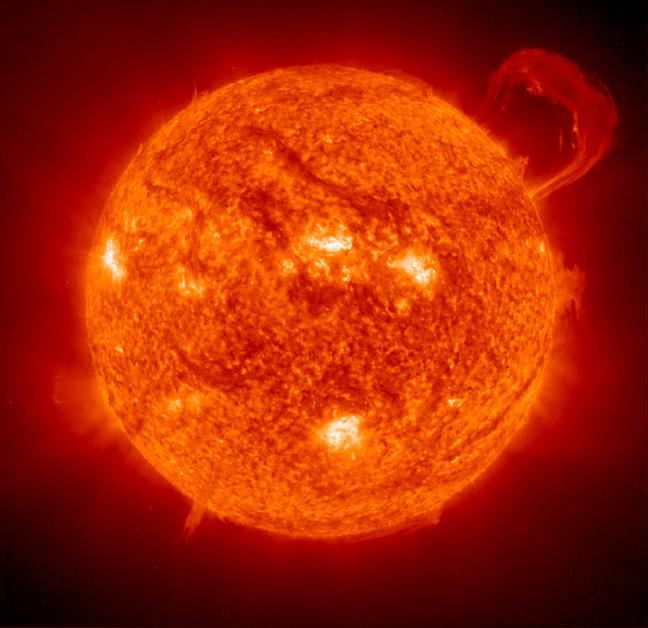
"To understand the physical phenomena of the Sun and stars—from their internal structure to their outer atmospheres—by studying their dynamics, their heating, and their interactions with interplanetary space."
Éric Buchlin, Solar and Stellar Team Leader
Our team’s research focuses on the Sun and stars in general. We study stars from their cores all the way to their distant atmospheres—which are tenuous but sometimes surprisingly hot, particularly in the case of the Sun.
The two main themes are:
- Dynamics and Internal Structure of the Sun and Stars (Helioseismology and Asteroseismology) Learn More
- Diagnosis and Heating of the Outer Layers (Coronal Heating and Solar Wind Acceleration; Diagnosis and Modeling of Protuberances; Stellar Activity…) Learn More
The team’s results in these areas (for the period 2008–2013) are summarized in thisreport(theteam’spublicationsfor this period).
To carry out its work, the team draws on data from several space missions and analyzes the observations available from various data centers.
The Team
- Thierry Appourchaux
- Frédéric Auchère
- Frédéric Baudin
- Karine Bocchialini
- Patrick Boumier
- Eric Buchlin (coordinator)
- Lucie Degott
- Jacques Dubau
- Ganushan Ganesaratnam
- João Marques
- Slimane Mzerguat
- Robin Odant (intern)
- Susanna Parenti
- Charly Pinçon
Regular External Contributors
- José Dias Do Nascimento
- Miho Janvier ( on secondment to ESA)
- John Leibacher
- Barbara Perri
Data Processing
The team bases its work on observations made by space missions (many of which are still in operation).
Team members are involved in data centers at the IAS, where they are responsible for and lead the scientific activities.
For solar physics, it is theMEDOC center, a national research hub for space-based solar physics. For stellar seismology, it istheCoRoTmission archive, the “Stellar Systems” component of the IDOC center.
Dynamics and Internal Structure of the Sun and Stars
Stars, including the Sun, are very often subject to oscillations around their equilibrium structure (natural vibration modes) that manifest as periodic shifts in their surface and variations in the star’s luminosity at the same periods. The speed of the photosphere’s movement can be measured using the Doppler effect, and precision photometry makes it possible to detect variations in luminosity. These measurements form the observational basis for helioseismology as it pertains to the Sun, and for asteroseismology for stars in general.
These oscillations are caused by two types of forces that tend to return the structure to equilibrium after it has been disturbed in any way: pressure, which gives rise to sound waves, and Archimedes’ principle, which gives rise to what are known as gravity waves.
The study of the natural vibration modes of stars provides essential information for understanding their physical properties: these modes depend on the star’s internal structure—variations in density, temperature, and chemical composition (abundance of helium and other heavier elements)—as well as on the star’s internal rotation profile.
The IAS is involved in the observation and interpretation of several space missions dedicated to helioseismology or asteroseismology.
On board the SOHO satellite (ESA/NASA), which observes the Sun from the Lagrange point, the IAS is responsible for the scientific and technical aspects of theGOLF(Global Oscillations at Low Frequencies) instrument, designed to observe global solar velocity oscillations with a spectral sensitivity on the order of 1 mm/s. TheLOI(Luminosity Oscillations Imager) on VIRGO/SOHO is an instrument that measures intensity oscillations using an imager consisting of 12 pixels. The IAS is also involved in the seismological aspects of the CNES Picard mission, which observes the Sun from Earth orbit.
In the field of stellar seismology, the IAS is heavily involved in the CNES’sCorotmission, which, based on high-precision photometric measurements, has as its primary scientific objectives the detection and study of stellar vibrations and the search for exoplanets. This mission has expanded the scope of asteroseismology to stars other than the Sun—some of which resemble the Sun, while others are quite different, such as red giants, which are stars at the end of their lives.
The IAS is also involved in the analysis and interpretation of data from NASA’s Kepler mission, which has further expanded the number of stars that can be studied using seismic methods, thereby providing a better understanding of the interiors of stars and their evolution.
Diagnosis and Heating of the Outer Layers
- Heating of the solar corona
The Sun’s upper atmosphere (the corona) has the remarkable characteristic of being maintained at temperatures on the order of one million degrees at all times, with episodes during which the temperature can be even higher, whereas the Sun’s surface does not reach 6,000 degrees. These temperatures can only be explained if thermal energy losses (through conduction, convection, and radiation) are offset by significant energy dissipation, likely of magnetic origin.
The physical processes leading to this dissipation are complex and involve both very large scales (100,000 km) and very small scales (100 m). The existence of small scales—certainly created by turbulence—is essential for the dissipation mechanisms to be effective. However, beyond the challenge of explaining observations of hot plasma in the corona, understanding these processes is important both because they could explain the formation of the coronas of stars other than the Sun, and because they play a role in the relationship between the Sun and Earth—a relationship that can become turbulent during solar storms.
The team’s work on this topic focuses primarily on the following areas: the statistical study of heating events, the simulation of their observable effects, the observation of the effects of the dissipation of certain waves, and heating within the “plumes” of polar coronal holes.
- Solar prominences and eruptive phenomena
Solar prominences are large-scale magnetic structures in which cold (less than 10⁴ K) and dense plasma is confined within the vast, hot (10⁶ K), and稀薄corona. In and of itself, the very existence of these structures poses a real challenge for physicists, both in terms of the balance of forces and energy. Since a prominence (commonly called a filament when viewed on the disk as an elongated dark region) is always located above a magnetic field reversal line, it is easy to see the role of the Lorentz force in preventing the material from falling. In reality, the situation is obviously more complex, if only because of the filamentation of the matter—which varies both in time and space—the nature of the plasma, which oscillates between a fully ionized and a fully neutral state, the propagation and dissipation of various waves, and so on…
The very existence and evolution of these structures make them a veritable natural laboratory for astrophysical plasmas, but there is another reason to study them: the important role they play, in conjunction with solar flares and CMEs, in space weather.
- Magnetic Activity of Stars
Magnetism therefore plays a major role in stellar physics. It manifests itself in various forms: eruptions, dark spots, and large-scale structures (coronal loops or prominences). In the case of stars, recent photometric measurements have made it possible to detect the signature of dark spots on the stellar surface, which are, in principle, similar to sunspots. However, the diversity of stars (in terms of age and mass) means that the magnitude of these signatures varies greatly from one star to another, allowing us to map the landscape of stellar magnetism, thereby placing our star among the others and, in turn, contributing to our understanding of its magnetism and its variations (such as the Sun’s 11-year cycle).